
Jump to content
Create New...
  • 💬 Join the Conversation

    CnG Logo SQ 2023 RedBlue FavIcon300w.png
    Since 2001, Cheers & Gears has been the go-to hub for automotive enthusiasts. Join today to access our vibrant forums, upload your vehicle to the Garage, and connect with fellow gearheads around the world.


  • William Maley
    William Maley

    How Much For The Ford Focus Electric?


    gallery_10485_267_645383.png

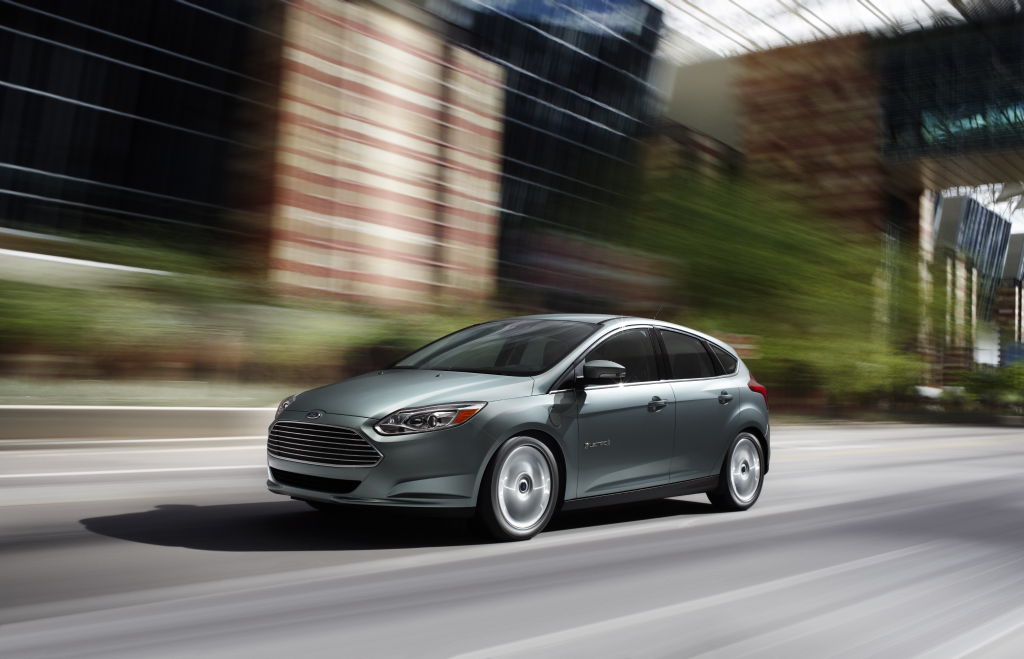
    The Ford Focus Electric has appeared on the company's website configurator this week with a base price of $39,200 before state and federal incentives, plus an additional $795 for destination charges. Compared the Chevrolet Volt and Nissan Leaf, the Focus Electric is the same price as the Volt ($39,995) and is $3,945 more than a base Nissan Leaf ($36,050).

    So what do you get for your $39,995? Well, the Focus Electric comes with a electric motor producing 123 HP and 181 lb-ft of torque and is fed by a 23 kwh lithium-ion battery system. Power goes through a single speed transmission to the front wheels. Ford says the Focus Electric can travel up to 100 miles on a single charge. A full charge can happen in 18-20 hours by a typical 120v outlet or 3-4 hours with a special 240v charger. Inside, MyFordTouch with Navigation, SYNC, Sony audio, push button start, and Ford's MyKey technology is standard.

    Only three options are available: Blue Candy ($395) and White Platinum ($495) paint, as well as leather seats ($995) to replace the standard cloth seats.

    Press Release is on page 2


    Ford Opens Reservations for 2012 Focus Electric

    • 2012 Focus electric is Ford’s first all-electric, 100% gas-free, passenger car and the first of five planned electrified vehicles
    • Detailed product specifications and virtually build and price available at online website:http://www.ford.com/...selectric/2012/
    • Ford Certified EV dealers in California and New York/New Jersey markets will begin taking first orders for the 2012 Focus Electric

    SEATTLE, WA., Nov. 2, 2011 – Starting today, drivers that want to go completely gasoline-free will be able to configure the all-new 2012 Ford Focus Electric online at Ford.com and place their orders with a Certified Electric Vehicle (EV) dealer.

    “Today is an historic day, as Ford opens up the order banks for the company’s first full production, all-electric passenger vehicle – the Focus Electric,” said Chad D’Arcy, Focus Electric Marketing Manager, Ford Motor Company. “The all-new Focus Electric is an important part of Ford’s overall strategy, bringing still another option to customers who want a car that is fun-to-drive, easy to own and fully electric.”

    Drivers interested in learning more about the 2012 Focus Electric will be able to see detailed product specs and virtually build and price one at a dedicated online website:http://www.ford.com/...selectric/2012/ starting Wednesday.

    Focus Electric comes standard with: MyFord Touch with 8-inch touchscreen; two driver-configurable 4.2-inch color LCD displays in cluster for unique EV driving screens; MyFord™ Mobile App (for remotely monitoring and scheduling battery charging with owners’ smartphone as well as remote start); HID Headlamps; 17-inch aluminum wheels, ambient lighting, seats made from 100-percent recycled material; Rear Camera with Rear Parking Sensor; Intelligent Access with Push-Button Start; MyKey®; voice-activated Navigation System; Particulate Air Filter; hands-free SYNC® Bluetooth telephone connectivity with Traffic, Direction and Information Services; electronic traction control; Sony®-Branded audio with nine speakers; SIRIUS® Satellite Radio and HD Radio™.

    The only options on well-equipped Focus Electrics are leather seats and two paint colors.

    “Ford believes driving electric doesn’t mean consumers should have to sacrifice on driving experience or vehicle quality,” said D’Arcy. “The Focus Electric comes with more standard features than any other comparable all-electric vehicle.”

    In addition to silently cruising past gas stations, Focus Electric drivers will never need oil changes or any of the other service required on gasoline engines. Focus Electric exclusively stores energy in an advanced lithium-ion battery pack. The battery pack uses liquid-cooling to help ensure a long-life and optimal performance under all weather and driving conditions.

    The Focus Electric’s battery can be recharged in just over three hours using a 240-volt charging station, about half the charging time of the 2012 Nissan Leaf. Drivers also can top off the battery any standard 120-volt outlet using the included charging cord.

    The online site also provides potential customers the ability to find the location of their nearest Ford Certified EV dealer so they can place their order.

    A limited number of Focus Electrics will first be available in California and the New York/New Jersey regions. Availability of the Focus Electric will expand next year to the remaining 15 launch markets as production ramps up.

    The 19 launch markets include: Atlanta, Austin and Houston, Texas; Boston, Chicago, Denver, Detroit, Los Angeles, San Francisco, San Diego, New York, Orlando, Fla., Phoenix and Tucson, Ariz.; Portland, Ore.; Raleigh Durham, N.C.; Richmond, Va., Seattle, and Washington, D.C.

    Markets were chosen based on several criteria, including commuting patterns, existing hybrid purchase trends, utility company collaboration and local government commitment to electrification.

    Power of choice

    Electrification is an important piece of Ford’s overall product sustainability strategy, which includes the launch of five electrified vehicles in North America by 2012 and in Europe by 2013. Ford launched the Transit Connect Electric small commercial van in 2010 and will launch the all-new Focus Electric later this year. In 2012, these models will be joined in North America by the new C-MAX Hybrid, a second next-generation lithium-ion battery hybrid and C-MAX Energi plug-in hybrid. This diverse range of electrified vehicles allows Ford to meet a variety of consumer driving needs.


    User Feedback

    Recommended Comments

    There are no comments to display.


    Join the conversation

    You can post now and register later. If you have an account, sign in now to post with your account.
    Note: Your post will require moderator approval before it will be visible.

    Guest
    Add a comment...

    ×   Pasted as rich text.   Paste as plain text instead

      Only 75 emoji are allowed.

    ×   Your link has been automatically embedded.   Display as a link instead

    ×   Your previous content has been restored.   Clear editor

    ×   You cannot paste images directly. Upload or insert images from URL.


  • Support Real Automotive Journalism

    Cheers and Gears Logo

    Since 2001, Cheers & Gears has delivered real content and honest opinions — not emotionless AI output or manufacturer-filtered fluff.

    If you value independent voices and authentic reviews, consider subscribing. Plans start at just $2.25/month, and paid members enjoy an ad-light experience.*

    You can view subscription options here.

    *a very limited number of ads contain special coupon deals for our members and will show

  • Posts

    • Personally I think GM is too late to the Hybrid party and rather than spend and write off all the billions of dollars on their EVs that are actually selling well, they should have stayed the course and not followed Stupid Ford and Idiot47. GM has a 'handful of hybrids' coming - but are they the ones you want? I do not see GM actually doing well in this space as they are already too far behind.
    • On a more positive note, travel related stuff ... A historic milestone was achieved by Cunard Line within the last week.  When she was built, Queen Mary 2 (QM2) was too big to transit the Panama Canal.  The same was true for other supersized passenger ships.  In the interim, new larger locks were engineered and put into service. https://travelweekly.com.au/queen-mary-2s-first-transit-through-panama-canal-on-way-to-australia/ I saw the QM2 enter San Francisco Bay in 2007 because I was living out West.  It came in on a Sunday and I spent the weekend south of the city and near SFO.  I went there in a rented 2007 Monte Carlo costing less than $25 a day and stayed at one of the cheap chain hotels near SFO costing about $50 a night, which was ridiculously cheap even then. The ship went around South America and sailed northward up the Pacific.  As such, it's not a trip they would be making too often with the QM2. QM2 transited the Panama Canal for the first time just days ago.  She is headed to Los Angeles AND San Francisco.  To clarify the article's headline, Australia is just its next leg - this is the full world cruise.  She was last in Los Angeles in 2006 when she saluted her namesake Queen Mary and last in San Francisco in 2007 and seeing the passage under the Golden Gate Bridge was unforgettable.  These were the only visits to these ports.  With the new Panama Canal locks, her visiting the North Pacific Ocean and its major ports is much more likely to be on future world voyages. In the Panama Canal transit, the nail biter was supposedly going under the Bridge of the Americas - the one with the curved top.  I saw this YouTube with passengers cheering and motorists up above honking. I blame my parents for this!  They took us across the Atlantic a time or two too many when we were kids and this fascination began.
    • WTF kind of article is this? Piss-poor grammar and sentences. "By the time the odometer ticked past that 160,000 kilometre mark, equivalent to 160,000 kilometres, 99,000, the pack still retained over 90 percent of its original net capacity." Then it jumps to 91% remaining capacity somehow...? And when jumping to 91% capacity remaining, I don't think they did any math at all. See below for a paragraph that shouldn't be made as evidence of anything. As an engineer, this kind of "facts" should infuriate you.  "Battery health statistics can sound abstract until you translate them into the range figure you see on your dashboard. In this case, the Volkswagen ID. 3 Pro S started life with a usable pack of 77 kWh, and independent testing recorded an initial real world range of 77 k and 272 miles on a full charge. After the long term trial, the car still had 91% of its battery capacity, a figure that aligns with separate reporting that the Volkswagen ID 3 retained 91% battery capacity in a 160,000 kilometre test. In practice, that meant the car lost only around eight miles of usable range, a change small enough that you would struggle to notice in daily driving." 272 x .09 = 24.5 miles. Theoretically losing 9% would lose the owner about 25 miles of range, not 8 miles. It is now a 248-mile range EV.  This looks like some garbage AI-generated article.  Just for the record, I'm not saying that EVs don't have good battery management and degradation. I'm just saying this article was an embarrassing example to stand by.
  • Who's Online (See full list)

    • There are no registered users currently online
  • My Clubs

×
×
  • Create New...

Important Information

We have placed cookies on your device to help make this website better. You can adjust your cookie settings, otherwise we'll assume you're okay to continue.

Hey there, we noticed you're using an ad-blocker. We're a small site that is supported by ads or subscriptions. We rely on these to pay for server costs and vehicle reviews.  Please consider whitelisting us in your ad-blocker, or if you really like what you see, you can pick up one of our subscriptions for just $1.75 a month or $15 a year. It may not seem like a lot, but it goes a long way to help support real, honest content, that isn't generated by an AI bot.

See you out there.

Drew
Editor-in-Chief

Write what you are looking for and press enter or click the search icon to begin your search