Jump to content
Create New...
  • 🚗 Your People Are Here. Get In.

    The internet is full of car content. This is the community.

    Cheers & Gears has been bringing enthusiasts together since 2001. Join the conversation, show off your garage, and find your people.

  • William Maley
    William Maley

    Review: 2013 Toyota RAV4 XLE AWD

      Patient Zero In The Compact Crossover Class Enters The Forth Generation.


    William Maley

    Staff Writer - CheersandGears.com

    December 17, 2013

    Author's Note: With 2013 coming to a close in a couple of weeks, we've decided to clear out the remaining 2013 vehicle reviews this week. Everyday a new review will appear on the front page. If you miss one day, don't worry, we'll have links to the previous reviews just below. -WM

    Monday: Nissan Maxima 3.5 SV

    Wednesday: Hyundai Santa Fe Limited AWD

    Thursday: Toyota Land Cruiser

    Friday: Lexus LS 600h L

    The compact crossover marketplace has become one of the most crowded and contested in the automotive world. It seems a month doesn't go by without news of a new or redesigned compact crossover. Automakers are trying to differentiate their crossovers by going somewhat daring with their designs, making them fun to drive, filling them with tech, and other items. But there is one thing some automakers can play to their advantage, name recognition. No one is more apparent of this than Toyota. The automaker is patient zero of the compact crossover marketplace with the RAV4, first introduced back in 1996. For the past three-generations, the RAV4 has been one of the best selling compact crossovers in the U.S. This past year saw Toyota introduce the latest-generation of the RAV4. The question of course is whether in light of fresh competition, can the RAV4 retain its title of being one of the best sellers?
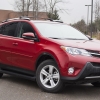
    2013 Toyota RAV4 XLE AWD 7

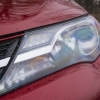
    With the fourth-generation RAV4, Toyota made drastic changes to the design. The most notable one is around back with Toyota retiring the swing-out tailgate and spare-tire carrier. Instead, the 2013 RAV4 features a standard liftgate with large taillights and a rear spoiler sitting on top. Moving to the front, the RAV4 has a new front clip with a split grille layout and chrome accent bars running into the headlights. Along the side, designers did some sculpting and added a bit of a downward slope to the roofline. A final touch for the RAV4's design is body cladding along the bottom of the entire vehicle. Much like C&G's Managing Editor Drew Dowdell said in his quick drive of the RAV4, I wasn't too keen on the design at first, but it has grown on me since then.

    Moving inside, the RAV4 features a mix of good and bad ideas. The good ideas start with an improved dashboard that features a leather-like material and stitching. There's also a color touchscreen radio that is standard across the range and can be equipped with the user-friendly Entune infotainment system with navigation on the XLE and Limited. While the graphics look somewhat dated compared to competitors, the interface is very intuitive.

    2013 Toyota RAV4 XLE AWD 12

    Other good ideas for the RAV4 include in airy cabin thanks to large amount of glass in the vehicle. The back seat provides comfortable seating for two people despite them being somewhat firmer than the ones up front. Cargo Space in the RAV4 is best in class with 38.4 Cubic Feet with the rear seats up and 73.4 Cubic Feet with the rear seats down.

    The bad ideas in the RAV4 begin with other materials used inside. Hard plastics are very noticeable all around the interior from the door panels to the center console. Certain pieces of interior are finished faux 'carbon fiber' looking trim which looks completely out of place. That trim also appears to have issues with quality as it looked pretty scratched up in this 10,000 mile example. Also, I wish Toyota would give the navigation system a dedicated button on the radio and not have it buried in the Apps section of the system.

    2013 Toyota RAV4 XLE AWD 15

    No Toyota. Just No.

    To find out how the RAV4's powertrain and suspension fared, see the next page.

    Only one engine is available, a 2.5L four-cylinder with 176 horsepower and 172 pound-feet of torque. A six-speed automatic comes standard, while the choice of front-wheel or all-wheel drive is available. My tester came with the all-wheel drive system. Despite having the lowest numbers powertrain-wise in the class, the RAV4 doesn't feel like it at all. This is due to the six-speed automatic which is smart enough to keep the four-cylinder right in the sweet spot of the power band.
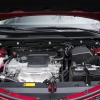
    2013 Toyota RAV4 XLE AWD 9

    You also have the choice of two different drive modes. ECO dulls the throttle response and limits the output of the climate control system. I only tried this setting a couple of times and didn't particular like it at all since it makes the four-cylinder feel very sluggish, like it's trying to move a vehicle that's three times heavier than the RAV4. Then there is Sport which improves the throttle response and quickens the shifts from the six-speed automatic. It does improve the performance and driving fun of the RAV4 somewhat.

    Fuel economy-wise, the EPA rates the 2013 RAV4 AWD at 22 City/29 Highway/25 Combined. My average for the week landed around 22 MPG.

    On the ride-and-handling front, the RAV4 sits right in the middle. The suspension is comprised of a MacPherson strut setup in the front and a double wishbone coil spring setup in the back that provided a very comfortable ride which was able to absorb bumps and imperfections. In the corners, the RAV4 feels confident around the corners and body roll is kept in check. While it's no match for the Mazda CX-5 in driving fun, the RAV4 should fill the role of being a crossover that gets you from point a to b with no problem. One area I wish Toyota would work on is minimizing the amount of road and engine noise coming into the cabin.
    2013 Toyota RAV4 XLE AWD 4

    Much like Drew in his conclusion of the RAV4, I have to say the RAV4 is just right. The total package from the powertrain to the list of standard equipment should help keep the RAV4 up there in the best selling compact crossovers. But I have to wonder this: What if Toyota gave the RAV4 a bit more time in development? Would it look somewhat like the Ford Escape or Mazda CX-5?

    Disclaimer: Toyota Provided the RAV4, Insurance, and One Tank of Gas.

    Year: 2013

    Make: Toyota

    Model: RAV4

    Trim: XLE AWD

    Engine: 2.5L DOHC 16-Valve Four-Cylinder with VTT-i

    Driveline: All-Wheel Drive, Six-Speed Automatic

    Horsepower @ RPM: 176 @ 6,000

    Torque @ RPM: 172 @ 4,100

    Fuel Economy: City/Highway/Combined - 22/29/25

    Curb Weight: 3,585 lbs

    Location of Manufacture: Woodstock, Ontario

    Base Price: $25,690.00

    As Tested Price: $28,552.00 (Includes $845.00 Destination Charge)

    Options:

    Display Audio with Navigation and Entune - $1,030.00

    Running Boards - $549.00

    Roof Rack Cross Bars - $229.00

    Body Side Molding - $209.00

    William Maley is a staff writer for Cheers & Gears. He can be reached at [email protected]or you can follow him on twitter at @realmudmonster.


    User Feedback

    Recommended Comments

    Having just driven a rental 2014 Camry SE with the same drive train, I was very unimpressed overall with the 2.5 and it's mileage. 0-60 performance was in the 9 second range(8.7 in sport mode) and I never came close to the reported 35 highway figure. Sounds like the Rav 4 averaging only 22 is also moving around more weight than it should. Why Toyota dropped an optional engine from a CUV and still offers it in there mid size sedan is a bit dumb.

    In comparison a rental 2013 Malibu 2LT did the 0-60 run in 7.7 seconds and got it's rated 34 on the open road on the same exact route and my buddies Kia Sorento FWD with the GDI 2.4/automatic feels quite peppy and gets 25 overall MPG.

    Link to comment
    Share on other sites


    Join the conversation

    You can post now and register later. If you have an account, sign in now to post with your account.
    Note: Your post will require moderator approval before it will be visible.

    Guest
    Add a comment...

    ×   Pasted as rich text.   Paste as plain text instead

      Only 75 emoji are allowed.

    ×   Your link has been automatically embedded.   Display as a link instead

    ×   Your previous content has been restored.   Clear editor

    ×   You cannot paste images directly. Upload or insert images from URL.


  • Support Independent Automotive Journalism

    25 years of honest automotive coverage — because someone has to do it.

    Cheers & Gears has never been filtered by manufacturer relationships or driven by algorithm. Just real people, real opinions, and a genuine love of cars. Subscribers keep the lights on and get an ad-light experience starting at $2.25/month.*

    View subscription options

    *A small number of ads feature member-exclusive coupon deals and will still appear.

  • Similar Content

  • Posts

    • Some of these famous buildings are hideous, some are interesting with decent parts to them, and a rare few are really nice. The hideous ones include the newer architecture building at University of Washington, Wurster Hall (also architecture) at UC Berkeley, and perhaps the Salk Institute in San Diego.  These buildings are cold and soul sucking, so they're hard to be in.  They also come from a fairly ugly (on various levels) sixties and seventies granola period. One of these buildings would be a "hybrid" and it's fine.  That would be Campbell Hall (again ... architecture) at the University of Virginia, which is definitely brutalist reinforced concrete at the first taller level or two, with an exposed waffle slab at levels above you.  However, they soften it up by using brick on the upper floors' exterior, as well as lower floor to ceiling heights.  The one brutalist gem would have to be the main library at University of California San Diego.  They definitely did not do this to reduce costs because it's a complicated building.  However, it's probably a nice space to be inside because of the floor to ceiling windows all around. It's just that there was a wave of putting up these buildings on West Coast campuses, surrounded by eucalyptus or fir and hemlock, and it was usually at hippieish campuses and their atmospheres don't gel with me.
    • Happy Mother's Day to the mothers in our lives - family, friends, coworkers  She came to mind, so I looked for a gif on her.  She is originally from Buffalo!  Most people have doubles.  I don't think she does. Happy Sunday.
    • Having looked at all the images online, I have to say that the interior and exterior other than the color which I like is a let down and I would even say for a Luxury brand looks cheap.
    • Due to my tradeshow season, do not have the time till June to do any writeups, but Lexus has released their Luxury version 3 row SUV EV that Toyota released as the Highlander and Subaru also has. Clearly not connected to the ICE Spindale grill or as many of us called the Predator mouth. https://pressroom.lexus.com/all-electric-three-row-luxury-the-all-new-2027-lexus-tz/ The press release says 300 miles of range on Select Grade. Look at the fine print, this is a sea level level road, anything else is 250 to 280 miles of range. FAILURE Lexus / Toyota along with the 400V system.
    • After doing a bunch of research on this, it isn't so much Honda/Acura are limiting charging speeds as it is the battery pack total size directly correlates to the rate of charge they can accept. The Prologue and non-SS Blazer EV have 85kWh batteries at 288 total volts and the ZDX/Lyriq/Blazer EV SS all have the larger 102kWh battery at 345 total volts.  Because of the way the Ultium platforms have multiple pack sizes that can and are linked together to make larger or smaller packs, the total pack volts varies based on the application and why the Hummer/Silverado/Sierra EVs can charge at 800v when they're still on 400v architecture.  Because kW = amps * volts, the bigger packs have more nominal volts because they have more cells.  Below is a Prologue example and change the 288v for the Prologue to 345v for the larger packs of the Lyriq, ZDX, or Blazer EV SS and you get 190kW for the maximum (or do the math for the other chargers, as well)
  • Who's Online (See full list)

  • My Clubs

×
×
  • Create New...

Important Information

We have placed cookies on your device to help make this website better. You can adjust your cookie settings, otherwise we'll assume you're okay to continue.

Hey there, we noticed you're using an ad-blocker. We're a small site that is supported by ads or subscriptions. We rely on these to pay for server costs and vehicle reviews.  Please consider whitelisting us in your ad-blocker, or if you really like what you see, you can pick up one of our subscriptions for just $1.75 a month or $15 a year. It may not seem like a lot, but it goes a long way to help support real, honest content, that isn't generated by an AI bot.

See you out there.

Drew
Editor-in-Chief

Write what you are looking for and press enter or click the search icon to begin your search