


Saying farewell to Scion
A few days before I got the 2016 Scion iM to do a week-long evaluation, news came out that Toyota would be closing the brand this fall. Most of the lineup, including the iM, would move over to Toyota. It feels somewhat weird to do a review on a brand that is essentially a dead man walking. But with the iM moving to the Corolla family, it would give us an idea of whether or not we recommend it.
The Scion iM is a rebadged Toyota Auris that is sold in Europe and Japan. There isn’t a lot of differences between two models aside from new mesh inserts for the front and 17-inch alloy wheels. The overall design is polarizing. The front is long and low, with a narrow grille and bumper that looks like it has fangs. Around back is an interesting shape for the tailgate.

In terms of comfort, the iM is mixed. On short trips, the front seats provide decent support. Longer trips reveals the lack of thigh support. The back seat is small with limited head and legroom. Cargo space is towards the small side with only 20.8 cubic feet, trailing the Volkswagen Golf (22.8 cubic feet) and Ford Focus hatchback (23.3 cubic feet).
Standard on the iM is a seven-inch touchscreen radio. It is your standard Toyota touchscreen system with a simple, if somewhat dated interface. The system is quick to respond when going between the various functions. Navigation is available as an option.
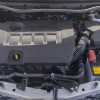
Power for the iM comes from the Corolla LE Eco, a 1.8L four-cylinder producing 137 horsepower and 126 pound-feet of torque. This can either be paired with either a six-speed manual or a CVT like our tester. Power delivery is not impressive as the engine can’t keep up with traffic and produces more sound than speed. Your foot will be near the floor if you want to try and get up to speed at a somewhat decent rate. The CVT seems to mesh with the engine better than the six-speed manual we drove last year. It is smart to know when it needs to increase or decrease engine rpm for various driving situations.
In terms of fuel economy, the iM equipped with a CVT is rated at 28 City/37 Highway/32 Combined. We didn’t get close to any of those numbers as we only recorded 25.3 MPG for the week. A lot of this can be attributed to the iM coming during one of the coldest weeks in Detroit where temperatures were between -10’ to 20’ Fahrenheit. Before I would go anywhere, I would start up the vehicle to let it warm up for a few moments. If it was a bit warmer, I wouldn’t be surprised I could get the EPA numbers.
One item I couldn’t fully report on during the iM first drive was how it rode. The particular vehicle I drove was fitted with some TRD suspension parts, giving me some different impressions from other folks that drove the standard model Now I can report on the iM’s ride and say it is pretty good. The iM provides a very forgiving ride on rough surfaces. This is partly due to the iM using an independent rear suspension and not the solid-axle setup found in the Corolla. We do wish Scion had put some sound deadening material in the iM as road noise comes in clear. Around corners, the iM doesn’t embarrass itself. There is little body roll and it feels composed. Steering is the weak point as it has rubbery feeling.
The one place where Scion iM comes out on top is price. The 2016 iM starts at $19,255 for the manual and $19,995 for the CVT. Our tester with a few accessories came to an as-tested price of $20,334. That includes the touchscreen radio, dual-zone climate control, alloy wheels, LED taillights, keyless entry, and a backup camera. No other car in the class comes close.
At the moment, we wouldn’t recommend the Scion iM. The engine is the big weakness as it can’t keep up with traffic and produces more sound than actual power. We also wished there was a little bit more cargo room. The low price does make it tempting, but a slightly used compact would be a better choice. As Scion drives off into the sunset and the iM heads over to Toyota, the automaker has its work cut out. There is a good car in the iM, but it needs a fair amount of changes. Whether Toyota does them or not remains to be seen.
Cheers: Price, Ride Quality, Out There Styling
Jeers: Lethargic Engine, Steering, Interior Space
Disclaimer: Scion Provided the iM, Insurance, and One Tank of Gas
Year: 2016
Make: Scion
Model: iM
Trim: N/A
Engine: 1.8L DOHC 16-Valve, Valvematic Four-Cylinder
Driveline: Front-Wheel Drive, CVT
Horsepower @ RPM: 137 @ 6,100
Torque @ RPM: 126 @ 4,000
Fuel Economy: City/Highway/Combined - 28/37/32
Curb Weight: 3,031 lbs
Location of Manufacture:
Base Price: $19,200
As Tested Price: $20,334 (Includes $795.00 Destination Charge)
Options:
Carpeted Floormats and Cargo Mat - $185.00
Rear Bumper Protector - $89.00
Wheel Locks - $65.00
Recommended Comments
Join the conversation
You can post now and register later. If you have an account, sign in now to post with your account.
Note: Your post will require moderator approval before it will be visible.