

Leaderboard
-
Drew Dowdell
Editor-in-Chief255Points56,349Posts -
William Maley
Editor215Points32,884Posts -

G. David Felt
Premium Subscriber74Points38,400Posts -
Anthony Fongaro
Editor16Points165Posts


Popular Content
Showing content with the highest reputation since 12/02/2009 in Articles
-
 The news came during dinner last Monday. My mother asked if I would be able to take any time off of work, and I said that I might be able to if the circumstances were considered important. She revealed that my grandfather, her dad passed away that afternoon. It wasn’t from COVID-19, but other complications that had put in him the hospital since early June. After dinner, I needed some time and space to begin processing the news. So I grabbed the keys to my car and went for a drive. The past few months have been difficult for all of us in varying degrees with COVID-19. Many places going on lockdown have caused massive disruptions to how we work, travel, and interact with the world. I have been hunkered down at home since mid-March when my employer announced our office would be closed for the time being, and we would be working from home. During the first month or so, I had put a moratorium on driving except for essential places such as the grocery store or pharmacy. Isolating to prevent catching and/or spreading the virus took priority over going for a drive. But after a month of just being in a house with family and doing the same things over and over, I was going stir crazy. I realized that I needed some space to not only prevent myself from losing it, but to give me some room to think about everything floating in my mind. Going for daily walks either by myself or with the dog helped a bit. But I still felt like I needed some more space, more time to myself. Back in 2015, I wrote an Afterthoughts column titled The Escape Machine. I talked about how the car for some of us was a way to escape the world for a time. You could go anywhere depending on how much fuel was in the tank and give the space needed to clear or process whatever was on the mind. I ended the piece with these two lines, That decision for me came in late April/early May. I would go for long drives, provided that I would wear a mask if I got out to go for a walk. Going for the first drive in over a month was a bit of revelation. Turing the steering wheel, pressing down on the accelerator and brake; and watching the world go past in blur made me realize how much I missed this. This seems like a trope, but you have a newfound appreciation for something you haven’t done in some time. This also gave me the space to begin piecing together various thoughts such as how do I keep myself from falling into the endless pit of despair, what can I do to keep myself from feeling bored, and do I dive back into automotive writing. I didn’t know how important this would become in the coming weeks as COVID-19 cases increased, the economy would come to a screeching halt; and the murder of George Floyd and the ensuing fallout. Whenever my mind would become overwhelmed or I just get too frustrated, I would hop into my vehicle and go somewhere. It didn’t matter where or how long, just as long as I had some space to think or to calm down, it would be enough. Back to last Monday night. As I drove, there was a lot I needed to process in terms of grief and wondering what would happen next: Would there be a funeral, what precautions should I take, will it be a long ceremony, and so on. I didn’t come up with any clear answers to these questions, but having that time to start putting things into perspective helped. It was on the way back that another thought popped into my head. At the moment, we’re all trying to find some sense of normal in a world that isn’t. For auto enthusiasts, that is to drive as it gives some sort of control. It may be a small thing, but they provide some much-needed comfort. Like many of us, I don’t what the rest of year holds if it continues to be a landfill fire or somehow begins to contain itself. But I do know that I’ll likely be taking more drives, whether that be my car or one that I’m reviewing. Having something that provides a sense of normal is welcomed.6 points
 -
 In a series of tweets today, Trump announced that General Motors will be selling their Lordstown plant to electric truck maker Workhorse. Lordstown was shut down in March of this year and formerly built the Chevrolet Cruze. The details of the plant sale have not yet been announced. Workhorse is a Cincinnati based company who builds EV pickups with a built in range extender, similar in concept to the Chevrolet Volt. Workhorse's sole model is the W-15, capable of driving up to 80 miles on a charge before a gasoline powered range extender kicks in. It uses two motors to provide all-wheel drive. The only configuration available is an extended cab with 6.5 foot bed. They can tow up to 5,000 lbs and have a payload of 2,200 lbs. Pricing starts at $54,500 before tax credits. Workhorse intends to start production for the retail market sometime in 2019. Fleet orders have already started. GM is not denying any of the information in the tweets from Trump. Update: General Motors has confirmed that talks are ongoing.4 points
 -
 During GM's earnings call today, GM announced that a new, highly flexible, EV architecture is on the way and that Cadillac will be at the center of the release. The architecture, called BEV3, is said to be highly flexible, being able to be configured from small sedans to large crossover formats, and front-wheel, rear-wheel, or all-wheel drive configurations. GM is targeting a sweet spot of 300 mile in range according to GM CEO Mary Barra. GM is going to continue its development of autonomous technology. It currently offers SuperCruise automated driving on the flagship CT6 sedan and plans to expand that technology across the Cadillac lineup. Late last year, GM announced that it would be canceling two of its plug-in hybrid vehicles in a slew of cutbacks in the sedan segment.4 points
 -
 The common thought today is that the sedan market in the U.S. is dying. If that's the case, the 2020 Toyota Corolla hasn't given any reasons that it should stick around. While styling could be considered bolder over the prior model, it is still bland in person. Front and rear facias nearly mirror each other in a Studebaker-like "is it coming or going?" way. The styling of the interior hasn't changed in any significant way though the materials are somewhat improved. Mediocre engine choices, unlike the 2020 Kia Soul, leave little to be excited over. The addition of a hybrid option is interesting, but only for people who think the Prius is too fugly to drive, otherwise, they would just buy the real thing. The Corolla is the best selling car nameplate in history, but this latest version leaves little reason for that record to continue. In a tough small sedan market, it is going to take more than just more of the same to move the needle. Dull, conventional, boring..... that's my opinion of the 2020 Corolla4 points
 -
 “I can’t believe we’re going to make it” This thought passed through my head as I brought the vehicle to a stop on an off-ramp. Somehow, I was able to travel from my house in the outskirts of Metro Detroit to my hometown of Midland, Michigan on just a quarter-tank of gas. That may not seem like a huge accomplishment except when you look at the vehicle I was driving, the 707 horsepower Jeep Grand Cherokee Trackhawk. Originally, I wasn’t planning on traveling to Midland in the Trackhawk. Earlier in the week, I had driven it down to an event in Ann Arbor to drive a couple of Mitsubishi vehicles. The trip revealed the thirst of the supercharged 6.2L V8 by using up a third of the gas tank. My plan for the rest of the time would be running errands and some small trips to get a feel of the vehicle. Over the weekend, I would get some work done and take photos. But that would be thrown out the window when my brother brought up the idea of heading to the Northwood Auto Show in Midland. The Northwood show takes place on the grounds of Northwood University. It is a unique auto show as the students of the school run all of the aspects of the show ranging from the planning to being the product specialists for each brand. This is part of their automotive and aftermarket degree programs. When I lived in Midland, the show was something I looked forward to every year as I would get the chance to sit in various new vehicles. Also, I would come home with a big bag of brochures that I would be reading throughout the year, letting all of the information seep into my brain. This may explain why I became so crazy about vehicles. It had been a few years since I last attended the show due to various factors such as not knowing when it would be put on. But I was surprised that it would be taking place around the same time I would have the Trackhawk. At first, I was hesitant to go. But then, my brother said the magic words, “I would be willing to pay for gas. I want to go for a ride in the Trackhawk.” Once those words came out of his mouth, I had decided that it would be a good idea to go to Northwood. But something else crept into my head. Would it be possible to travel to the show on a limited amount of gas? I decided to put it to the test. Saturday morning, my brother and I got into the Trackhawk to head towards Midland. Starting up the vehicle, the supercharged V8 thundered to life and the gas gauge rose to just a hair over a quarter of a tank. My plan was to put the vehicle into Eco mode and use the radar cruise control to travel at a steady speed of 75 mph. The instant fuel economy screen would be up in the instrument cluster to let me monitor and make adjustments as needed. I would stop for gas when the distance to empty notification reached 15 miles or under. As I began to pull away from the house, my brother noticed that the vehicle was in Eco mode. “I think its more of a suggestion than an actual mode,” I said when he brought it up. To demonstrate what I meant, I pushed the throttle to almost the floor on an on-ramp. The V8 engine roared into life with the supercharged screeching. Even in Eco, it is quite shocking how fast this brick picks up speed. “I get what you mean by this being a suggestion,” my brother said to me as we merged onto I-75. The trip from my house to Northwood is about 90 miles. The trip computer told me that I would be out of gas in 90 miles. Cue “Challenge Accepted” picture. The first 15 to 20 miles of the trip was a bit nerve-racking. Watching the instant fuel economy fluctuate between 10 to 15 as the vehicle would slow down and accelerate as other vehicles came into its path. I began to worry about my goal of reaching Midland was all for naught. But as we traveled further on I-75, my confidence began to grow. The engine settled down and cruise at just a hair above 2,000 rpms. The fuel gauge was steadily going down, but my average fuel economy was rising. It wasn’t till we passed the small town of Auburn, that car flashed its low fuel light. The vehicle said it had 30 miles till it reached empty. I knew that Midland was only ten or so miles away and decided to push it. The gauge continued to fall as did the distance to empty. I held my breath until we got onto the off-ramp. Just a few hundred feet away was a gas station. We had done it with just 20 miles to spare. According to the car, I had an average of 15.1 mpg for the trip. I know there will be someone who will be saying: “Why did you this? Aren’t you missing the point of this vehicle?!” No, I know the point of the Grand Cherokee Trackhawk is to go stupid fast. Defy the laws of physics. But that is what every review (including mine that will be coming in the near future) goes on about. I wanted to do something a bit different and look at it from a different angle. I think my brother said it best about this whole experience as I got back into the car after getting some gas, “I wasn’t expecting that to happen.”4 points
 -
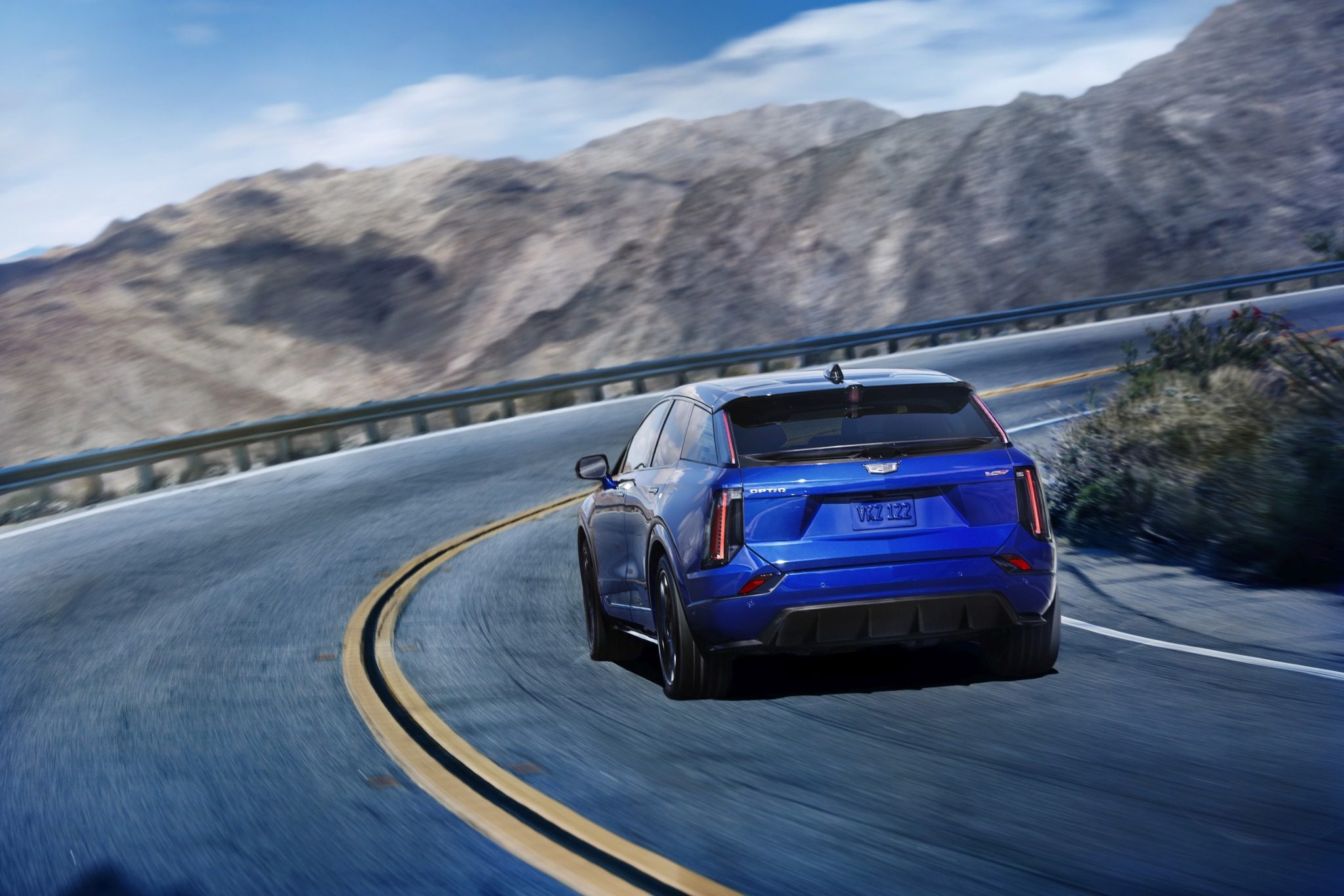 We reported back in April that Cadillac would be releasing a V-Series version of their OPTIQ EV for the coming model year, joining the Cadillac Lyriq-V in the V-series lineup. Today we finally get the details. 519 HP, 3.5-Second Sprint, and NACS Charging While the base Cadillac Optiq already makes 300 horsepower, the OPTIQ-V bumps that up to a robust 519 hp and 650 lb-ft of torque when the car is in Velocity Max mode. That is sufficient to sprint to 60 in just 3.5 seconds. Carrying an 85 kWh battery pack, Cadillac's preliminary range estimate comes in at 275 miles. Naturally, that range would decrease with a lot of Velocity Max driving. For charging, the OPTIQ-V is the first GM vehicle to come standard with the NACS charge port. Home charging at 240V is available at 7.7kW, 11.5 kW, and if a 100-amp breaker is available, 19.2 kW. DC Fast-Charging allows the OPTIQ-V to take on power at a rate up to 70 miles in 10 minutes. Accessing Velocity Max is done through the V-Mode button on the steering wheel or in the drive mode app in the center screen. V-Mode allows the driver to customize their experience and pre-select performance settings that are activated by the V-Mode button. Drivers can select from Launch Control for maximum straight line acceleration and Competitive Mode for extra traction management to enhance agility. Handling is managed by Continuous Damping Control (CDC) dampers. Brembo performance brake calipers are standard on the front and available in blue or red with a V-Series logo. When you want the car to take over driving, Super Cruise is standard and available for use on approved roads. All Go, Plenty of Show Cadillac makes sure other drivers know you're in something special with V-Series specific looks. The front fascia is unique to the OPTIQ-V, complete with the signature V-Pattern mesh lower grill, high gloss black front splitter, and body color lower trim. A Carbon Fiber package is available which upgrades the front splitter, rear diffuser, and rear mid-spoiler to carbon fiber. Wheels are 21-inch satin graphite alloy by default or optional 21-inch dark painted sport wheels are available. The roof is painted black standard with a panoramic fixed-glass section while two new limited-edition exterior colors: Magnus Metal Frost and Deep Ocean Tintcoat join the color palette. V-Series badging is placed prominently around the exterior. The Inside Counts Too Optiq-V offers two interior color schemes: Noir with Santorini Blue accents or Noir and Sky Cool Gray with Santorini Blue accents. An additional darker accent fabric is woven from yarn made from 100-percent recycled materials. Standard genuine carbon fiber trim decorates the center console. The standard audio system is a 19-speaker AKG Studio unit with Dolby Atmos paired with a 33-inch diagonal LED display. Starting price for the OPTIQ-V rings up at $68,795, including destination charges and before taxes and fees. Check out the 2026 Cadillac OPTIQ-V photo gallery for more angles on this electric pocket rocket.3 points
 -
 Ford is upgrading the Mustang Mach-E for 2024 with a longer range and faster charging. The entire lineup gets an upgraded rear motor that boosts range to 320 EPA-rated miles with the extended range battery and rear wheel drive. While that number is up 20 miles from the 300-mile range of the 2021 Mach-E extended range, Ford had already made a change to the batteries in 2023 that earned RWD extended-range models a 310-mile rating. Standard-range rear-wheel drive models also see a 20-mile improvement over the original 2021 Mach-E. All-wheel drive models see a boost in range of 10 miles. The new rear motor, developed by Ford, drops weight and improves torque. The performance improvements allow the Mustang Mach-E GT Performance to bolt to 60 in just 3.3 seconds with a quarter-mile time of 11.8 seconds at 114 mph. Ford claims this makes that trim of the Mach-E faster than a Tesla Model-T Performance and a Porsche Macan 4 Electric. Speaking of the GT, the GT Performance trim is no longer a stand-alone model. In prior years, Ford offered the Mach-E in a standard GT and a GT Performance trim. Instead, the Performance Upgrade package is a software update that can be purchased with the car or purchased and enabled seamlessly later. Previously, the GT Performance trim only boosted torque by 34 lb-ft, but this new Performance Upgrade package boosts torque by a full 100 lb-ft. Previously, features only available on the GT Performance are now included in the GT trim and include Ford Performance front seats, MagneRide Damping system, and Brembo front brake calipers. The Performance Upgrade software back costs $995. Other improvements across the lineup are a simplified Infotainment system screen with new icons to make it easier to get to important information and a reconfigured settings screen because Ford said "users don't like to scroll". Wireless Android Auto and Wireless Apple CarPlay are still standard. Ford also improved the Fast charging speed on a DC charger. With the new updates, a standard range Mach-E will charge from 10% to 80% 5.7 minutes faster (32.2 minutes total) than the original, while an extended range battery improves charge speed by 8.8 minutes (36.2 minutes total). Ford recently joined the Tesla Supercharging network, which added 15,000 new chargers to the Ford BlueOval network. Charging with the Tesla network is as simple as plugging in, with billing handled directly through BlueOval. For now, the Mach-E comes equipped with a CCS charge port, so owners of the Mach-E will need a free adapter from Ford to use Tesla charging stations. Ford had recently dropped the price of the 2023 Ford Mustang Mach-E to just $39,895, but the 2024 model creeps up slightly to $39,995 for the Select RWD standard range. The RWD Premium starts at $43,495, and the GT starts at $53,995. The new Mustang Mach-E Rally goes on sale for $59,995. All models add a $1,895 delivery charge.3 points
 -
 The hottest and most competitive segment in the auto industry is the compact crossover, with every mainstream brand fielding at least one or more entries. Fresh off updating the Trax, Trailblazer, Blazer, and Traverse in the last two years, Chevy is circling back to update its bread-and-butter Equinox. Equinox's current platform came out in 2018 with a mild nip-tuck in 2022. For 2025, the Equinox gets a major redesign, inside and out, on the same platform. The headliner for this release is the new ACTIV trim. Representing a ruggedized version of the Equinox, the ACTIV has a unique front fascia, blacked-out badging, 17-inch machined aluminum wheels, a Maple Sugar / Black interior scheme, and an available white roof. The current LT and RS trims also each have distinctive front fascias, a C-pillar shark fin, All-LED lighting, and several wheel choices up to 20 inches for RS. The RS is also available with a black roof. The Equinox's interior has received a major refresh focusing on tech. New is an 11-inch diagonal, reconfigurable instrument cluster and an angled 11.3-inch infotainment screen featuring Google built-in. CarPlay and Android Auto device mirroring will be offered. The gear selector has been moved to the steering column in a stalk on the right side of the wheel, opening up room for more console storage in the center. All models have standard heated steering wheels and front seats. RS buyers get a flat-bottomed steering wheel and can add ventilated front seats and rear heated outboard seats. The Equinox comes standard with a host of automatic detection and reaction systems, including: Automatic Emergency Braking Forward Collision Alert Front Pedestrian and Bicyclist Braking Following Distance Indicator Lane Keep Assist with Lane Departure Warning IntelliBeam Additional standard safety and driver assistance features include: Side Bicyclist Alert Rear Vision Camera Rear Seat Reminder Adaptive Cruise Control Lane Change Alert with Side Blind Zone Alert Enhanced Automatic Emergency Braking Rear Cross Traffic Braking Rear Park Assist Enhanced Lane Keep Assist The 1.5-liter turbocharged 4-cylinder carries over from last year's model, producing 175-horsepower at 5,600 RPM. Torque and transmission specifications vary by driveline with the front-wheel drive models producing 184 lb-ft and routing through a CVT while all-wheel drive models make 203 lb-ft and use a traditional 8-speed automatic. When equipped with all-wheel drive, the Equinox can tow up to 1,500 pounds. View the gallery below to see more of the 2025 Chevrolet Equinox Expect the 2025 Chevrolet Equinox to be available in mid-late 2024.3 points
 -
3 points
 A friend of mine has a 2016 Subaru Legacy 3.6R. It’s a very safe car, has a good interior, and a rather weak engine. Oh, it also has a CVT or continuously variable transmission. When I talked with him while he took me for a spin, he told me he doesn’t mind the CVT and it is smooth for his Lyft passengers. While being a passenger in his car, the CVT did act like a conventional transmission, although it did dip in the rev range lower than usual. Then he floored it. Drone. It stayed at 3,000 RPM for at least five minutes. It was extremely annoying, but not surprising. Let me explain how a CVT works, and how I think manufacturers need to stop using them. Nerd moment approaching. You will learn many facts and you are welcome. As a surprise, a CVT is an automatic transmission. Manufacturers use this to improve fuel economy. What isn’t surprising is how they work. Instead of using traditional gears, a CVT uses a combination of pullies that are connected by a belt and “steps” . Steps are artificial gears which are preset and made so buyers feel like they’re getting a convenient transmission. Some CVTs, especially in hybrids, tend to not have steps to maximize fuel economy. They are more less compared to traditional transmissions, even 10-speed automatics, but manufacturers think they are worth it. Are they? I do have to point out the positives, no matter how much I dislike this transmission. They can be smooth. Since there is no actual shifting, when a CVT wants to behave, acceleration can feel less jerky compared to a traditional transmission. CVTs have infinite ratios, so they can find the right…ratio…to assist not only with seamless power. They do help with fuel economy which is part of the reason why most Toyota hybrids have forgone the traditional automatic transmission in favor of the CVT. Positive points over, let’s shift to what I hate about the CVT. First, You won’t find a CVT in a powerful car over 300 HP. They just can’t handle all that power! Like I said in the first paragraph, they can drone and be almost obnoxiously loud. I once drove a Honda Accord Hybrid in Colorado, and it decided to stick to 4,000 RPM at 60 mph. For 2 hours. Needless to say, the average sounding sound system was necessary to drown out the noise. My biggest issue with any CVT is that it robs the driver of spirited and fun driving. I have never driven a CVT, gotten out of the car, and said “Wow, this was really fun. I’m glad that this engine and transmission combination exist.” Now, which companies are the biggest culprits? Japanese companies. Toyota, Nissan, Subaru, and Honda all use CVTs in mostly all their vehicles, and in all of their hybrids. A few other companies such as Audi will use a CVT in their cheaper models, but most of their cars use dual-clutch automatics or traditional automatics. A disappointment of a vehicle created with a CVT is the Infiniti QX50. It is a handsome looking vehicle with a unique turbocharged engine and…a CVT. Basically, it’s ruined because of the CVT. I understand why manufacturers use CVTs due to how smooth it can be along with the increase in MPG , but they just seem to ruin the cars. I don’t understand why they can’t use dual-clutch automated manual or 8-10 speed automatics? These transmissions are getting better all the time. Manufacturers, stop with the CVTs! They are not necessary! Just use regular transmissions! They can return similar MPG, drive smooth, and won’t stick to 4,000 RPM for 2 hours while in Colorado. I can safely say that I hate the CVT, and I think that I’m not the only one. Have you driven a vehicle with a CVT and either liked or disliked it? Did you decide not to buy a vehicle with a CVT or were you sold on the two benefits it has? Let us know in the comments below and follow us on social media.3 points
 -
 During a recent fireside chat with Bank of America, Ford teased a new 'Whitespace' product due in the 2021MY. What could that product be? Muscle Cars & Trucks speculates this may be a smaller pickup truck. We've been hearing rumblings about this since 2018 when Automobile Magazine first brought this to light. This truck would be the replacement for the Brazilian market Courier, last sold in 2013. It would be based on the C2 platform that underpinned at the time the new Focus for markets outside of the U.S. Fuel would be added to the fire a year later when Jim Farley, Ford's president of global markets dropped this, Since then, a trademark filing for Maverick by Ford has appeared, possibly giving us a name for this new model. Plus, dealers were shown this model earlier this year where it earned an enthusiastic reception. This model could have a starting price of around $20,000 or so when it launches. Stay tuned. Source: Muscle Cars & Trucks3 points
 -
 Rarely, do I get the chance to drive different versions of the same model. The fleet companies I work with scheduling vehicles do their best to serve up a smorgasbord of vehicles for me to experience. But from time to time, things happen where one vehicle in a run has to be swapped because it needs to go home or is required for an important event. It happened to be that the stars aligned in such a way that two Volvo 60 series models would be swapped for various vehicles in this go around. So I found myself with an S60 Momentum one week and a V60 Cross Country another week. A prime opportunity to experience two different takes on the same model. Design: Same and Different Both of the 60 models continue Volvo’s design of simple elegance. The smooth boxy shape is contrasted by the “Thor’s Hammer” lighting element in the headlights and a sloping beltline along the side. Compared to the larger S90, the S60 looks cleaner. This can be attributed to the rear where the license plate has been moved from the bumper to the trunk and a raised lip on the trunk lid. The optional 19-inch wheels fitted on my tester look somewhat out of place as it removes some of the understated look the sedan is trying to present. The V60 Cross Country certainly looks the part of an off-road wagon with a three-inch lift to the suspension, body cladding along the side, different grille color, and new wheel choices. Around back, Volvo takes some ideas from their crossovers with the tailgate being similar in design to XC40 and XC60, and the tall L-shaped headlights. Out of the two, I found myself liking the V60 Cross Country more than the S60. Inside Story The simple elegance philosophy continues inside for both the S60 and V60. The dash features a simplistic design with clean lines and minimal brightwork. Both vehicles feature some surprising interior touches such as wood trim and machined metal pieces. The S60 does falter slightly as some interior pieces are hard plastics with some texturing. This is due to the S60 being the base Momentum trim, higher trims swap this for soft-touch material. Both the S60 and V60 feature front seats that provide an excellent balance of support and comfort. Ten-way power adjustments allow any person to find a setting that fits them. I also like both models coming with the optional power thigh extender to make long drives more bearable. Rear seat space is a mixed bag as there is plenty of legroom in both models, but headroom is constrained in the S60 due to the sloping roofline. In terms of cargo, the V60 Cross Country is the champ. Open the power liftgate and you’re greeted with 23.2 cubic feet. This can be expanded to 50.9 cubic feet with the rear seats folded. The S60 trunk space is slightly disappointing, only offering 11.6 cubic feet. At least the rear seats can be folded down to increase load capacity. Non-Sensus-ical Infotainment All S60 and V60s come with a nine-inch screen featuring Volvo’s Sensus infotainment system. A large screen oriented like a tablet to control most of the functions fits in line with the company’s minimalist approach. But using this system becomes quite infuriating. To start, Sensus takes over a minute to boot up whenever the vehicle is started. You’ll be able to tell since the system will not respond or respond slowly whenever an input is made during this. Thankfully, the system responds quickly once it fully boots up. This brings us to another problem with Sensus, its confounding menu system. Trying to do something simple such as increase fan speed or turn on/off a safety system means swiping into various screens and menus to find that button or slider. Apple CarPlay and Android Auto is standard and does make Sensus slightly easier to use. But I think some real improvements will come when the next version of Sensus comes out that will be based on Google’s Android platform. I’m also hoping for some more redundant controls such as a fan knob or temperature buttons. When Five equals Four Both models come equipped with the T5 engine. Before you start thinking that this means a turbocharged five-cylinder, T5 in current Volvos means a turbocharged four-cylinder engine producing 248 horsepower and 258 pound-feet. An eight-speed automatic is the only transmission choice. Opting for the T5 on the S60 means you only get front-wheel drive - you’ll need to step to the twin-charged T6 or PHEV T8 for all-wheel drive. As for the Cross Country, it gets all-wheel drive as standard. The T5 is a very potent engine as I found in my review of the XC40 last year and that still holds true for both 60 series models. No matter the situation such as needing to pass a slower truck or leave a stoplight, the turbo-four is eager to move the vehicle at an astonishing rate. The eight-speed automatic is smooth and delivers prompt shifts. On the Cross Country, Volvo has an Off-Road mode that turns on a low-speed function, hill descent control, and optimizes the steering to keep the vehicle moving through whatever muck. For most buyers, this mode will never be touched at all. But I found it to be very handy driving through unplowed roads. EPA fuel economy figures stand at 23 City/34 Highway/27 Combined for the S60 and 22/31/25 for the V60 Cross Country. I got an average of 24.7 for the S60 and 23.1 in the Cross Country on a 60/40 mix of highway and city driving. A Smooth Ride Is Here, Provided You Have the Right Wheels As I mentioned earlier, the S60 I had came with a set of optional 19-inch wheels. This introduces a problem as the ride feels choppy. Over various bumps and imperfections, the S60 wasn’t able to smooth over a fair number of them. I assume going with the standard 18-inch wheels solves this issue somewhat, although some people report the ride is still rough on the smaller wheels. The V60 Cross Country also has a set of 19-inch wheels, but it is noticeably smoother over rough surfaces. Credit must be given to the higher ride height and softer suspension tuning. Wind and road noise are almost non-existent, making both perfect long-distance travelers. Handling is where the S60 redeems itself somewhat. The sedan shows little body and impressive grip when driven through a winding road. I do wish the steering had a little bit more weight, but that may be solved by moving to the R-Design or Polestar models. The Cross Country is a vehicle you want to push due to its softer suspension tuning. Two Good Models, But One Stands Tall The new 60 models are worthy successors to the models before it. An elegant design and mostly roomy interior pair nicely with the strong performance from the T5 engine. Sensus is the biggest stumbling block for both models, but a new version is around the corner which may solve some of the issues. Between the two, I found myself being more impressed with the V60 Cross Country. It has more character in its design compared to the S60 and the ride is much more comfortable. The almost $57,000 price-tag is a bit much, but with some smart optioning, you can make it much more reasonable. As for the S60, I did find it to be quite a decent steer. But the ride does need some work when on the larger wheels. Also, the Momentum can get quite expensive if you go overboard with options. My tester carried a nearly $46,000 price tag, three-grand more than the T5 versions of the R-Design and Inscription which come with some of the optional features as standard. The S60 and V60 Cross Country are excellent alternatives to the usual suspects, just be careful on the options. How I would configure them: There are two different ways I would go configuring an S60. Value: Start with the Momentum T5 at $36,050 and add Heated Front Seats & Steering Wheel ($750) and Premium Package ($2,050) to end up with a nicely equipped S60 at $39,845. You will miss out on some items such as the 360’ camera system, pilot assist, and Harman Kardon audio system, but that pushes the price to over $44,000. Sport: An R-Design T6 fits the bill here and comes with all-wheel drive as standard for a price of $48,045. Decide which metallic paint you would like ($645) or stick with the basic black. Add on the Advanced Package and Heated Rear Seats and Steering Wheel to end up with a final price tag of $51,645 for black or $52,290 for any of the metallic colors. For the V60 Cross Country, it would be similar to my test vehicle with most of the option packages and adding the Harman Kardon Premium Sound system ($800) to bring the final price to $52,795. Disclaimer: Volvo Provided the S60 and V60; Insurance, and One Tank of Gas Year: 2020 Make: Volvo Model: S60 Trim: T5 Momentum Engine: 2.0L Turbocharged DOHC Inline-Four Driveline: Eight-Speed Automatic, Front-Wheel Drive Horsepower @ RPM: 250 @ 5,500 Torque @ RPM: 258 @ 1,500 Fuel Economy: City/Highway/Combined - 23/34/27 Curb Weight: 3,657 lbs Location of Manufacture: Ridgeville, SC Base Price: $36,050 As Tested Price: $46,249 (Includes $995.00 Destination Charge) Options: Advanced Package - $2,500.00 Premium Package - $2,050.00 Multimedia Package - $1,850.00 19" 5-Spoke Cut Wheels - $800.00 Heated Front Seats & Heated Steering Wheel Package - $750.00 Pebble Grey Metallic - $645.00 Linear Lime Deco Inlay and Interior High Level Illumination - $600.00 Year: 2020 Make: Volvo Model: V60 Trim: Cross Country Engine: 2.0L Turbocharged DOHC Inline-Four Driveline: Eight-Speed Automatic, All-Wheel Drive Horsepower @ RPM: 250 @ 5,500 Torque @ RPM: 258 @ 1,500 Fuel Economy: City/Highway/Combined - 22/31/25 Curb Weight: 4,202 lbs Location of Manufacture: Gothenburg, Sweden Base Price: $45,100 As Tested Price: $56,990 (Includes $995.00 Destination Charge) Options: Bowers and Wilkins Premium Sound - $4,000.00 Cross Country Pro Package - $2,800.00 Advanced Package - $2,500.00 Heated Front Seats & Heated Steering Wheel Package - $750.00 Birch Light Metallic - $645.00 Park Assist Pilot - $200.003 points
 -
 This week, Hagerty obtained a document from General Motors' executive director in charge of program management, Michelle Braun that says development on future car and truck programs has been paused due to the COVID-19 outbreak. But the document also mentions some intriguing information on upcoming powertrains for the C8 Corvette. Here are the details, Corvette Z06: 5.5L DOHC V8 known as the LT6 that will produce 650 horsepower and 600 pound-feet of torque. No mention of any type of forced-induction. Corvette Gran Sport: 6.2L OHC V8 with a hybrid system that's expected to produce 600 horsepower and 500 pound-feet of torque. Corvette ZR1: Twin-Turbo 5.5L DOHC V8, dubbed LT7. Output is expected to be 850 horsepower and 800 pound-feet. Corvette Zora: The powerhouse of the C8, it will take the Twin-Turbo LT7 and augment with a hybrid system. This is expected to produce 1,000 horsepower and 975 pound-feet of torque. Hagerty's report says the rollout of the new engines will begin in 2022 with the LT6, but the COVID-19 outbreak may push the plans back. Source: Hagerty3 points
 -
 Buick is introducing a Sport Touring package for 2020. The ST is available on the Enclave Essence trim and includes a unique grille with body color surround, 20-inch machined aluminum wheels. The ST remains powered by the same 3.6-liter V6 producing 310 HP and 266 lb-ft of torque, the same unit in all other Enclaves. Other features added to the rest of the Enclave lineup include a new next-generation infotainment system with 8-inch diagonal screen. When equipped, the system supports SiriusXM with 360L which combines satellite and streaming to deliver more content. The setup requires a subscription to both SiriusXM All Access and GM Connected Vehicle services (on-board WiFi). The rear vision camera has been upgraded to High-Def and a High-Def Surround vision system. Standard on the Premium and Avenir, the driver and front passenger seat are upgraded with 4-way power lumbar and a massaging seat. Three new colors are available: Champagne Gold Metallic, Dark Moon Blue Metallic, and an Avenir only Rich Garnet Metallic. The 2020 Buick Enclave goes on sale late summer with a starting price of $41,195 including destination charge.3 points
 -
 BMW is renowned for their inline 6-cylinder engines, Mercedes and Land Rover are jumping back in the game, GM has a new diesel inline 6, now add Mazda to that list. Jalopnik combed through the Mazda financial report and found references to the new engine line. Mazda is apparently working on a 6-cylinder version of their Skyactiv-X engine for use in longitudinal applications. In case you need reminding, Skyactiv-X is Mazda's spark controlled, compression Ignition technology that allows the engine to run in spark-less mode part of the time. This allows for lower emissions and higher fuel economy. One of the trade-offs is lower engine refinement when in SCCI mode. Now that Mazda has it working well on 4-cylinder engines, it is apparently going to try its hand on mathematically better balanced inline 6-cylinder engines. Mazda is also planning on including 48v Mild-hybrid and plug-in hybrid versions of the engine as well. Also on the plan is an inline-6 Skyactiv-D diesel that Mazda is calling a second generation. This likely builds on the know-how gained from the development of the Mazda CX-5 Diesel that was finally released at the New York Auto Show. What both of these engines point to is a new large vehicle platform which is rear-wheel drive based. It's possible that the next iteration of the Mazda CX-9 could ride on this new platform and Jalopnik even speculates a new Mazda 6, though we have our doubts on that. Either way, this continues Mazda's slow but steady move up-market.3 points
 -
 Consumer Reports has rescinded the "Recommended" rating after a high number of survey responses came back with reliability complaints. Survey respondents have indicated that the electronics in the car have issues such the screen freezing or acting as though it was being touched rapidly in multiple locations. This issue would cause music to play, volume to increase to maximum, or the navigation map panning and resizing. Some owners reported issues with trim and paint, with a few, including CR themselves, experiencing a large crack in the rear glass. When the Model 3 came out in 2017 it received an initial rating of average based on the fact that it shares so much technology with the then average rated Model S. Some early adopters reported issues with braking that dropped the score to below average. Telsa issued an over-the-air update to correct the braking issue and the score returned to average. The Model S's rating has been inconsistant as Telsa has made hardware changes over the years. CR dropped the "Recommended" rating from the Model S in the fall of 2018 due to issues with the suspension. Tesla made AWD and air suspension standard on the Model S for model year 2017. The Model X has always had a below average rating and has never earned a "Recommended" largely due to problems with its falcon-wing doors. Tesla is expected to debut a new crossover this year along with the production version of its Semi-truck.3 points
 -
 Chevrolet didn't want to have Ford hogging the spotlight today in terms of heavy-duty pickups, so they spilled some more details on the upcoming Silverado HD at an event in Flint, MI. Let's start with some big numbers. Chevrolet is claiming all dually Silverado HDs are capable of towing over 30,000 pounds, with max being 35,500 pounds for a regular cab, 2WD model with the 6.6L Duramax Turbodiesel V8. This bests the Ram Heavy Duty's max towing of 35,100 pounds. Max payload sits at 7,466 pounds. To handle all of this weight, Chevrolet has beefed up the frame, axles, prop shafts, and improved cooling. In terms of the engines, Chevrolet is finally talking about the new gas engine they have been teasing for some time. It a 6.6L V8 producing 401 horsepower and 464 pound-feet of torque - up 41 and 84 when compared to the current 6.0L V8. This is paired up with a six-speed automatic. Optional is the 6.6L Duramax Turbodiesel V8 with 445 horsepower and 910 pound-feet of torque, teamed with a ten-speed automatic. Like the recently announced GMC Sierra HD, the Silverado HD will get the ProGrade Trailering system featuring 15 camera views, including a transparent trailer view that can see through a trailer while towing. Chevrolet will be rolling out the Silverado HD later this summer. Gallery: 2020 Chevrolet Silverado HD Source: Autoblog , Roadshow3 points
 -
 For almost two decades, Cadillac has been undergoing a transformation of sorts to become a threat to likes of BMW and Mercedes-Benz. The various models and changes have been met with mixed reactions. But the latest move to make Cadillac the lead brand in General Motors' electric car offensive marks a big change. According to an executive, this is the brand's last chance at success. “We don’t have any chances left with taking Cadillac to a really new place. This is pretty much it,” said GM President Mark Reuss to Reuters. “So we really have to hit the ball here. It’s my job to make sure we do.” Cadillac previewed their first EV on Sunday night during the press preview of the XT6 crossover. No name was given, but the model appears to be a small or midsize crossover. It will be the first vehicle to use GM's dedicated BEV3 platform that has been designed to underpin various types of vehicles and drivetrain layouts. When asked how long it would take for Cadillac to transition to an all-electric lineup, Reuss said it is too early to tell. He expects a combination of electrified and combustion engine models “for quite a few years” in the lineup. Reuss did not elaborate what would happen if the transition to electric faltered. “All I’m focused on is what we’re doing right now…” Reuss said, “and getting momentum back in Cadillac.” Source: Reuters3 points
 -
.jpg.7458570fe8ed0fe1531ecddc7695f811.jpg) During the reveal of the 2020 Cadillac XT6, Cadillac also took the wraps off a yet to be named Cadillac EV. This will be the first car on the new BEV3 platform that was announced just a few days ago at the GM Investors meeting. The new BEV3 platform is capable of FWD, RWD, or AWD variants and can be spun into many different body styles as customer tastes change. Technical details will be released at a later date3 points
During the reveal of the 2020 Cadillac XT6, Cadillac also took the wraps off a yet to be named Cadillac EV. This will be the first car on the new BEV3 platform that was announced just a few days ago at the GM Investors meeting. The new BEV3 platform is capable of FWD, RWD, or AWD variants and can be spun into many different body styles as customer tastes change. Technical details will be released at a later date3 points -
 Infiniti will be showing the QX Inspiration concept at the North American International Auto Show in Detroit next week. The concept shows the direction Infiniti wishes to take in both vehicle styling and technology. Infiniti hints that the vehicle will have "complete range confidence" leading us to believe that they expect EV range to meet or exceed the EV range from competitors like Jaguar and Tesla. Infiniti promises a sensual, handcrafted, interior with "Japanese DNA" INFINITI's new concept will be revealed in Detroit on Jan. 14, 11:40 a.m. EST3 points
 -
2 points
 Walmart is making one of the largest InHome delivery services changes of any company. By the end of 2024, the Chevrolet BrightDrop 400 electric van will be deployed in the Austin, Dallas, Denver, Detroit, Northwest Arkansas, Orlando and San Francisco Bay delivery markets reducing the footprint of CO2 output as they increase the efficiency of their InHome delivery services from Walmart stores. This reduction in carbon emissions along with providing a safe, efficient and comfortable vehicle for delivery will improve the groceries delivery experience. Those associates who have been trained and are already using the BrightDrop 400 vans have stated they are impressed with the 360-degree HD surround vision camera system, blind-zone steering assist, battery range, reliability and maneuverability. Walmart provided these takeaways from the initial pilot: The vans easily navigated congested roads and dense neighborhoods. Automation features such as auto-closing doors boosted efficiency and improved the associate experience. The low-step ergonomic design allowed easy entrance and exit of the vehicles, allowing for swift and efficient last-mile deliveries. From freezing cold to hot humid places, the BrightDrop delivered on a superior solution for real-world use over the pilot program that led to this massive roll out of delivery vans. The BrightDrop 400 are built at the Canada CAMI Assembly plant, built with advanced safety features for ultimate alertness, safety, low step-in height to ease of driver egress and a large info display allows each driver to have the ultimate driving experience with safe delivery of customers purchases. More details on the BrightDrop electric commercial mobility can be found here: Chevrolet BrightDrop Website2 points
 -
 Expanding its offerings today, Rivian unveiled the Rivian R2, expected to go on sale in early 2026. This new model rides on a new platform and is smaller than its big brother, the Rivian R1, by nearly 15 inches in length and 12 inches in height. The first question and second questions on people's minds when revealing a new electric vehicle are cost and range. In this, the Rivian R2 will come to market with an expected $45,000 base price and an EV range of 300 - 320 miles, depending on the configuration. Rivian is expected to enable Tesla Supercharger access in the next few weeks, more than doubling the number of charging plugs available to Rivian drivers, and the R2 will ship with the Tesla-designed NACS port natively. Smaller Platform, Three Motor Options While this is a new platform, Rivian was careful to keep the details familial. The R2 will be built, at least initially, at Rivian's Normal, Illinois plant to enable a faster ramp-up for 2026, though production could move to Rivian's new plant in Georgia once that comes online. Unlike the R1, which is available in dual- or quad-motor configurations, the R2 will be available as a single-motor rear-wheel drive, a dual-motor all-wheel drive, and a tri-motor all-wheel drive. In top spec, the R2 is capable of sprinting to 60 in under 3 seconds. Every version of the R2 will have at least 300 miles of range. Exact charging speeds haven't been released, but Rivian claims charging from 10-percent to 80-percent will take less than 30 minutes on a DC-Fast Charger. You can see in the Rivian R2 size compared to the Rivian R1S to the left, there is a significant difference in size between the two vehicles. (Click image to enlarge) Clever Features the R1 Didn't Have The R2 gets some neat features not on the Rivian R1. One of the main bits of feedback Rivian received about the R1 was over the lack of a glovebox, and Rivian overcompensated in the R2, with not one, but two gloveboxes. The rear window can lower into the hatch like in a Toyota 4-Runner and the rear C-panel windows pop out for additional ventilation. All four seats, yes, including the driver's seat, fold flat to allow for an in-vehicle camping experience. Keeping with their adventure theme, the R2 has some off-road credible specs with 9.8 inches of ground clearance, 32-inch tires, a 25-degree approach angle, and 27-degrees of departure angle. Rivian also had a "... and one more thing" moment and unveiled the Rivian R3, an even smaller crossover based on the R2. Be sure to check out the Rivian R3 story also. Reservations for the Rivian R2 are open now at Rivian.com. Check out the Rivian R2 photo gallery for more angles on this adventure-ready EV.2 points
 -
 It's time to roll back the clocks, and one of Cher's most famous songs, "If I Could Turn Back Time" debuted in 1989. That same year, automakers introduced at least 51 new models to the public. Each week for the next four weeks, we'll take a look at some of those cars, and you vote for which car would make you wish you could turn back time. The categories will be Family Car, Sports Car, Luxury Car, and Exotic. 1989 was a good year for people who liked sports cars as many fun new options hit the market. Mitsubishi Eclipse / Eagle Talon / Plymouth Laser – This trio from Mitsubishi was a product of the Diamond-Star Motors partnership with Chrylser. While built with all-wheel drive in mind, the first year of these cars was front-wheel drive only, with AWD coming to the Eclipse and Talon in 1990 and to the Laser in 1991. Three engine variants were offered; a 92 horsepower 1.8 liter 4-cylinder with SOHC, a 2.0 liter 16-valve DOHC with 135 horsepower, or a 2.0-liter DOHC Turbo with either 180 horsepower (automatic transmission) or 190 horsepower (manual transmission). The Eclipse got the broadest selection of engines, trims, and options with the Plymouth roughly matching it. The Talon was aimed at higher performance and did not get the base engine. All three have a hood bulge that is commonly thought to be for the turbo; however, it is actually to give clearance to the DOHC valvetrain. All three were relatively well received; however, the Laser never sold as well as the Eclipse or Talon and was dropped at the end of the model run. Nissan 240SX – This rear-wheel drive sports coupe and hatchback replaced the famed 200SX in 1989. While there are visual differences, the 240SX is largely a direct counterpart to the Japanese market Silvia. This car was known for its excellent handling due to its light weight and rear-wheel drive. American models were let down with a relatively underpowered 2.4 liter SOHC 4-cylinder that produced only 140 horsepower, while Japan and Europe got to enjoy a turbo-intercooled 1.8 liter. Transmissions were either a 4-speed automatic or a 5-speed manual. The coupes offered a heads-up display with a digital speedometer are part of a convenience package. Mazda Miata MX-5 – The MX-5 is the only car in this list to survive in production to the current day. Entering the market in September 1989 as a 1990 model, the MX-5 Miata was an instant classic. It took the formula of an English roadster and gave it handling plus Japanese reliability. In January 1990, it was awarded Car of the Year by Automobile Magazine. The MX-5 owed its great handling to a lightweight double wishbone suspension at all four wheels. Power was not amazing at only 115 hp and 100 lb.-ft of torque, but with a base curb weight of only 2,120 lbs., it still provided plenty of fun. The standard transmission was a 5-speed manual, but an automatic could be selected with a 10 hp penalty. The Miata's legendary manual transmission was conceived to have as short a throw as possible with minimal effort. Those who prefer simplicity could opt for the base model with steel wheels, roll-up windows, and no stereo or air conditioning. This first-generation Miata was in production for 8 years with 431,506 units produced. Ford/Mercury Capri - If you hail from down under, another sports car debuted that would eventually make its way to the US, the Ford Capri. Production of the Capri started in 1989. It was built using Mazda 323 mechanicals in a body designed by Ghia. It was intended from the start to be a Ford Australia export model for the US market. Problems with parts and production delayed export until the 1991 model year. While heavier than the Miata, the Capri was saddled with a base SOHC engine of 1.6 liters that produced a mere 82 horsepower. Buyers could option up to a 1.6 liter DOHC turbo with 134 horsepower, but that was only available with a 5-speed manual. The initial teething problems with parts, roofs leaking, low power output, and front-wheel drive left shoppers skeptical. Only 66,279 Capris were produced. So which of these 1989 Sports Cars would you own if you could turn back time?2 points
 -
 Chevrolet announced today that July 18th will the day they drop the curtain on the 2020 Chevrolet Blazer EV. This will be an all-new, all-electric midsize crossover built on GM's Ultium platform. Ultium is a joint venture between General Motors and LG Energy Solutions to provide flexible battery and powertrain solutions for any size of vehicle. Ultium was initially released in the GMC Hummer pickup. The Blazer EV is set to go on sale in Spring of 2023. That same year, Chevy will also launch the Silverado EV and Equinox EV while Cadillac is launching the Celestiq ultra-luxury sedan. In addition to the Blazer EV trims, Chevy is planning an SS version to rival the Mustang Mach-E GT Performance Edition. While we don't yet know the specs, expect a target near the 480 horsepower and 634 lb-ft of torque the Ford has.2 points
 -
 The Jeep Wrangler is going green with the introduction of the 4xe. This plug-in hybrid version of the Wrangler pairs a 2.0L turbo-four with a transmission-mounted electric motor. Total output is 375 horsepower and 470 pound-feet of torque, making this the powerful production Wrangler to date. A 17.0-kWh, liquid-cooled battery pack battery pack mounted under the rear-seat provides the electric juice and allows the 4xe to travel up 25 miles on electric power only. The transmission is an eight-speed automatic. Jeep hasn't revealed how long it takes to charge up the 4xe. Before you start thinking that going plug-in hybrid lessens the capability, Jeep says the 4xe models come with Dana 44 axles front and rear, and the various electronics have been waterproofed - allowing it to ford up to 30 inches of water. Base and Sahara models come with a two-speed transfer case with automatic four-wheel-drive mode and a 2.72:1 low-range. Rubicon models feature a transfer case with a 4:1 low-range, electronic locking front and rear axles with a 4.1:1 ratio, and an electronic sway bar disconnect. The 4xe does give up cargo space, with 27.7 cubic feet behind the rear seats (down four) and 67.4 with the rear seats folded (down five). It is also heavier with the base model coming at 5,000 pounds - about 800 pounds heavier than the gas model. Jeep will begin selling the Wrangler 4xe early next year in the three trims mentioned above. You'll only be able to get it in the four-door version. Expecting pricing to be above $30,000 or so. Source: Jeep Press Release is on Page 2 New Jeep® Wrangler 4xe Joins Renegade and Compass 4xe Models in Brand’s Global Electric Vehicle Lineup Advanced, Eco-friendly, Premium Technology Delivers Absolute and Quiet Open-air Freedom, an Even More Fun-to-drive On-road Experience and a New Level of Benchmark Jeep® Off-road Capability 4xe electric vehicle technology is the natural evolution of nearly 80 years of Jeep® capability leadership Jeep 4xe vehicles provide new levels of efficiency, environmental responsibility, performance and capability, on and off the road Jeep Wrangler 4xe available in Europe, China and the United States by early 2021; Jeep Renegade 4xe and Compass 4xe models began arriving in Europe this summer Wrangler 4xe boasts 375 horsepower and delivers up to 25 miles of pure electric operation for daily commutes while providing nearly silent, zero-emission, open-air freedom without range anxiety Torque-on-demand electric power enhances Wrangler’s on-road performance, delivering crisp launches from a standing start and plenty of low-speed thrust Low-speed, peak torque-on-demand raises Wrangler’s legendary off-road benchmark to master off-road environments Wrangler 4xe is first and foremost a Jeep Wrangler with Trail Rated running gear: solid front and rear axles, full-time 4x4 two-speed transfer case, fully articulating suspension and 30 inches of water fording capability Wrangler 4xe’s advanced turbocharged 2.0-liter four-cylinder engine, two electric motors and robust TorqueFlite eight-speed automatic transmission combine to deliver an estimated 50 MPGe 400-volt, 17 kWh, 96-cell battery pack mounts beneath second-row seat to protect it from outside elements and to preserve the interior space Wrangler 4xe features exclusive exterior design cues to signify efficient, environmentally friendly, electrification technology Available for order in Europe, Jeep Renegade 4xe and Compass 4xe deliver up to 240 horsepower and approximately 50 kilometers (31 miles) of zero-emission pure electric range September 3, 2020 , Auburn Hills, Mich. - The Jeep® brand has introduced its new Wrangler 4xe, marking the arrival of the most capable, technically advanced and eco-friendly Wrangler ever. Jeep Wrangler 4xe models will be available in Europe, China and the United States by early 2021. The Jeep Renegade 4xe and Compass 4xe models – introduced last year in Geneva – began arriving in Europe this summer. The new Jeep 4xe models follow the introduction of the Jeep Grand Commander PHEV in China last year. The Wrangler 4xe’s plug-in hybrid powertrain is capable of up to 25 miles of nearly silent, zero-emission, electric-only propulsion, making it commuter friendly as an all-electric daily driver without range anxiety and the most capable and eco-friendly Jeep vehicle off-road – combined with the open-air freedom that only Jeep Wrangler offers. Jeep will offer electrification options on each nameplate in the next few years as it strives to become the leader in eco-friendly premium technology. Electrified Jeep vehicles will carry the 4xe badge. Jeep electric vehicles will be the most efficient and responsible Jeep vehicles ever, taking performance, 4x4 capability and driver confidence to the next level. “Our Jeep 4xe vehicles will be the most efficient, responsible and capable that the brand has ever created,” said Christian Meunier, Global President of Jeep Brand - FCA. “We are committed to make Jeep the greenest SUV brand. The electrification of the Jeep lineup will allow commuters to travel solely on electric power, delivering an efficient and fun on-road experience and offering an ability to enjoy even more Jeep capability off-road in nearly complete silence.” The Wrangler 4xe’s advanced powertrain provides a unique on- and off-road experience through the combination of two electric motors, a high-voltage battery pack, a high-tech 2.0-liter turbocharged I-4 engine and robust TorqueFlite eight-speed automatic transmission. The most advanced powertrain ever developed for a Jeep Wrangler maximizes efficiency with an estimated 50 miles per gallon equivalent (MPGe) while eliminating range anxiety, delivering pure-electric operation for most daily commutes. Torque from the electric motors in the Wrangler 4xe’s hybrid powertrain arrives instantly on demand from the driver. The powertrain also delivers fuel-saving, seamless, start-stop operation of the engine. Jeep has demonstrated 4x4 capability leadership for nearly 80 years. Jeep vehicles were the first to feature an automatic full-time four-wheel-drive system, first 4:1 transfer case and first electronic front sway-bar disconnect system. Merging electrification into the product lineup is a natural evolution. The Jeep Wrangler 4xe will be sold globally, with electric vehicle (EV) charge port plugs tailored to specific regions. It is assembled at FCA’s Toledo Assembly Complex in Toledo, Ohio. Wrangler 4xe Advanced Powertrain Combines Electric Motors, Turbo Engine The Jeep Wrangler 4xe powertrain integrates two electric motors and a 400-volt battery pack with a fuel-efficient, turbocharged, four-cylinder engine and TorqueFlite eight-speed automatic transmission. This configuration maximizes the efficiency of the hybrid propulsion components and mates them with the Wrangler’s world-renowned and proven driveline. Key elements of the Wrangler 4xe powertrain include 375 horsepower (280 kW), 470 lb.-ft. (637 N•m) of torque and an estimated 50 MPGe from the following components: 2.0-liter turbocharged I-4 Engine-mounted motor generator unit Transmission-mounted motor generator unit integrated into eight-speed automatic transmission (ZF 8P75PH) 400-volt, 17-kWh, 96-cell lithium-ion, nickel manganese cobalt battery pack The 2.0-liter turbocharged I-4 engine is part of FCA’s Global Medium Engine family. The high-tech, direct-injection engine uses a twin-scroll, low-inertia turbocharger mounted directly to the cylinder head, along with a dedicated cooling circuit for the turbocharger, intake air and throttle body for exceptional responsiveness, performance and fuel efficiency. A high-voltage, liquid-cooled motor generator unit mounts at the front of the engine, replacing the conventional alternator. A robust belt connects the motor generator to the engine crankshaft pulley. The motor generator spins the engine for nearly seamless, fuel-saving, start-stop operation and generates electricity for the battery pack. The Wrangler 4xe does not use a conventional 12-volt starter motor. The Wrangler 4xe is equipped with a 12-volt battery to run accessories. The second high-voltage motor generator is mounted at the front of the transmission case, replacing the conventional torque converter of an automatic transmission. Two clutches work to manage power and torque from the e-motor and engine. A binary clutch (on/off) is mounted between the engine and the motor. When this clutch is open there is no mechanical linkage between the engine and the e-motor, which enables it to propel the Wrangler 4xe in electric-only mode. When the binary clutch is closed, torque from the 2.0-liter engine and the e-motor flow combine through the automatic transmission. A variable clutch mounted behind the e-motor manages engagement with the transmission to improve drivability and efficiency. Battery Pack Preserves Interior Room The Jeep Wrangler 4xe’s 400-volt, 17-kWh, 96-cell lithium-ion battery pack uses nickel manganese cobalt (NMC) graphite chemistry. The pack and controls mount underneath the second-row seat, where it is protected from outside elements. The Wrangler 4xe’s second-row seat is redesigned, allowing the bottom cushion to flip forward for access to the battery. Encased in an aluminum housing, the pack is fitted with a dedicated heating and cooling circuit to keep the battery at its optimum temperature for best performance. The temperature control circuit includes a dedicated heater unit and a chiller that uses the Wrangler air-conditioning refrigerant to reduce coolant temperature when needed. The Wrangler 4xe hybrid system includes an Integrated Dual Charging Module (ICDM), which combines a battery charger and a DC/DC converter in a single unit that is more compact than two separate components, and a next-generation Power Inverter Module (PIM) that is reduced in size. These components are housed and protected from damage in a steel structure mounted below the battery pack. All high-voltage electronics, including the wiring between the battery pack and the electric motors, are sealed and waterproof. Like all Trail Rated Jeep Wranglers, the Wrangler 4xe is capable of water fording up to 30 inches (76 cm). The electric charge port features a push-open/push-close cover and is located on the left front cowl of the Wrangler 4xe for convenient nose-in parking at charging locations. The charge port includes LED indicators of charging status. An LED battery level monitor is mounted on top of the instrument panel, making it easy to check battery state of charge at a glance during charging. Wrangler 4xe E Selec Modes The Jeep Wrangler 4xe driver can tailor the hybrid powertrain to best suit each trip, whether it is filling the needs of most daily commuters in pure-electric operation, a night on the town or quietly exploring nature off-road. The Wrangler 4xe hybrid powertrain has three modes of operation, known as E Selec. The driver can select the desired powertrain mode via buttons mounted on the instrument panel, to the left of the steering wheel. Regardless of the mode selected, the Wrangler 4xe operates as hybrid once the battery nears its minimum state of charge. Hybrid: The default mode blends torque from the 2.0-liter engine and electric motor. In this mode, the powertrain will use battery power first, then add in propulsion from the 2.0-liter turbocharged I-4 when the battery reaches minimum state of charge Electric: The powertrain operates on zero-emission electric power only until the battery reaches the minimum charge or the driver requests more torque (such as wide-open throttle), which engages the 2.0-liter engine eSave: Prioritizes propulsion from the 2.0-liter engine, saving the battery charge for later use, such as EV off-roading or urban areas where internal combustion propulsion is restricted. The driver can also choose between Battery Save and Battery Charge during eSave via the Hybrid Electric Pages in the Uconnect monitor To help optimize the benefit of the E Selec modes, the Wrangler 4xe driver information display and the Uconnect touchscreen feature Eco Coaching Pages. The Eco Coaching Pages let owners monitor power flow and see the impact of regenerative braking, schedule charging times to take advantage of lower electric rates, and view their driving history with a detail of electric and gasoline usage. Regenerative braking is a key part of the Wrangler 4xe eco-friendly equation. When the driver steps on the brake pedal, the powertrain control engages the maximum available regenerative braking, up to 0.25 g, from the electric motors to slow the vehicle, augmented with the Wrangler’s traditional friction brakes. The regenerative braking feature also extends the replacement period for brake pads. With 4x4 engaged, all four wheels feed torque for regenerative braking, maximizing the energy recovery. Electricity due to regenerative braking is fed to the battery pack to maintain or increase the state of charge. The Wrangler 4xe also features the ability to maximize regenerative energy production via a driver-selectable Max Regen feature. When Max Regen is engaged, a more assertive regenerative braking calibration occurs when the vehicle sees zero throttle input from the driver (coasting). Max Regen can slow the Wrangler 4xe faster than standard regenerative braking and generate more electricity for the battery pack. Once selected, the Max Regen feature remains engaged until driver deselects it. Off-road Legend Jeep Wrangler’s heritage is defined by its legendary off-road capability. All Wrangler 4xe power modes are available when the drivetrain is shifted to 4Lo. The seamless integration of electric power into the 4x4 drivetrain elevates the Wrangler 4xe to new levels of off-road performance. Enthusiasts will find that the instant availability of torque from the Wrangler 4xe’s electric motor delivers a more precise and controlled driving experience for climbing and crawling – there’s no need to build up engine rpm to get the tires to move, minimizing driveline shock loading and maximizing control and speed. In EV mode, the Wrangler 4xe treads lightly and silently, conserving fuel and allowing occupants to focus solely on the sights and full sounds of nature. The new Jeep Wrangler 4xe is available in three models: 4xe, Sahara 4xe and Rubicon 4xe. Wrangler 4xe and Wrangler Sahara 4xe models are equipped with full-time 4x4 systems, front and rear next-generation Dana 44 axles and are fitted with the Selec-Trac two-speed transfer case with a 2.72:1 low-range gear ratio. The intuitive system allows the driver to set it and forget it in any environment. An available Trac-Lok limited-slip rear differential provides extra grip and capability in low-traction situations, such as driving over sand, gravel, snow or ice. Wrangler Rubicon 4xe models carry the Rock-Trac 4x4 system that includes a two-speed transfer case with a 4:1 low-range gear ratio, full-time 4x4, front and rear next-generation Dana 44 axles, Tru-Lok electric front- and rear-axle lockers. The Wrangler Rubicon 4xe has an impressive crawl ratio of 77.2:1, which makes scaling any obstacle easy. Wrangler Rubicon models also offer improved articulation and total suspension travel with help from a front axle, electronic sway-bar disconnect. Together, these components contribute to the maximum off-road prowess Wrangler Rubicon is known for. The Wrangler 4xe includes Selec-Speed Control with Hill-ascent and Hill-descent Control. This allows drivers to control vehicle speed up and down steep, rugged grades with the transmission shift lever. Like every Jeep Wrangler, the Jeep Wrangler 4xe models wear a Trail Rated badge that signifies legendary 4x4 capability with equipment that includes: Skid plates and front and rear tow hooks Wrangler Rubicon 4xe approach angle of 44 degrees, breakover angle of 22.5 degrees, departure angle of 35.6 degrees and ground clearance of 10.8 inches (27.4 cm) Aggressive, available, 17-inch, off-road wheels and 33-inch tires standard on Rubicon 4xe; 20-inch wheels standard on Wrangler 4xe and Sahara 4xe Up to 30 inches (76 cm) of water fording All 4xe models maintain Wrangler’s renowned ease of customization with a host of Jeep Performance Parts from Mopar, available when the vehicle arrives in showrooms. ‘Electric Blue’ Design Cues Mark Wrangler 4xe The 2021 Jeep Wrangler 4xe maintains a sculptural design aesthetic that’s bold and functional, with a wide stance and trapezoidal wheel flares. Exclusive content identifies the Jeep Wrangler 4xe as the most technologically advanced Wrangler ever. New Electric Blue coloring on the front and rear Rubicon tow hooks stands out against the black bumpers. The unique blue coloring also traces the Rubicon name on the hood, Jeep badge and the Trail Rated badge. Select Easter egg design cues also receive the Electric Blue shade. The black hood decal is outlined in the special color with “4xe” that lets the body color show through. Inside, the Wrangler 4xe Rubicon includes unique Electric Blue stitching on the seats and trim. The 2021 Jeep Wrangler 4xe is available in 10 exterior colors: Black, Bright White, Firecracker Red, Granite Crystal Metallic, Hella Yella, Hydro Blue (late availability), Sting-Gray, Snazzberry, Sarge and Billet Silver Metallic. Two Wrangler interior options are available in the 4xe version: Black with Heritage Tan cloth and Black with Dark Saddle leather. Jeep Renegade 4xe and Jeep Compass 4xe Presented globally in March 2019 at the Geneva Motor Show, the new Renegade 4xe and Compass 4xe are the first Jeep models with plug-in hybrid electric technology available in Europe. Their arrival was celebrated in January with the exclusive First Edition – a special launch edition made available for customer previews and pre-booking on a dedicated website for select European markets. Renegade 4xe and Compass 4xe began arriving in the European market this summer. Both Renegade 4xe and Compass 4xe models feature a no-compromise hybrid solution that integrates the unmatched technical layout of each Jeep SUV and takes their capability to the next level through some of the most advanced technology, which combines enhanced performance (up to 240 horsepower), improved safety (four-wheel drive is always available) and low environmental impact (less than 50 g/km of CO2 in the hybrid mode). The combination of a 1.3-liter turbocharged gasoline engine and the electric unit guarantees performance and extraordinary driving pleasure: acceleration from 0 to 100 km/h in less than 7.5 seconds and full electric top speed is 130 km/h, which reaches 200 km/h in the hybrid mode. With the new hybrid technology, Jeep Renegade 4xe and Compass 4xe further improve their benchmark off-road capability courtesy of the greater torque offered by the combination between the two power sources. Thanks to the new Jeep 4xe technology, traction to the rear axle is not provided by a prop shaft, but through the dedicated electric motor. This allows the two axles to be separated and control the torque independently in a more effective way than a mechanical system, giving instant electric boost to the rear wheels when needed. The new Jeep Renegade 4xe and Jeep Compass 4xe began arriving in Jeep dealerships across Europe this summer with a full lineup to include Limited, S and Trailhawk trims, all with four-wheel-drive configuration. Mopar and Jeep Performance Parts Supports Launch of Most Capable, Technically Advanced, Eco-friendly Jeep Wrangler Ever When the new 2021 Jeep Wrangler 4xe (pronounced 4byE) plug-in hybrid joins the Jeep brand’s global electric vehicle lineup later this year, Jeep Performance Parts and Mopar will offer a wide variety of factory-engineered, quality-tested performance parts and accessories for the most capable, technically advanced and eco-friendly SUV on the planet. The comprehensive portfolio of more than 300 Jeep Wrangler products will include exclusive Jeep Performance Parts (JPP) offerings, allowing customers the opportunity to expand upon the Wrangler’s fun-to-drive on- and off-road experiences. An industry-first, OEM-developed JPP 2-inch lift kit is specifically engineered and tuned for the Wrangler 4xe plug-in hybrid application. Additional products will include beadlock-capable wheels, off-road bumpers, LED off-road lights and rock rails, just to name a few. More detailed information will be available closer to launch. In addition, Jeep Performance Parts and Mopar will offer a 240-volt at-home electric vehicle (EV) wall charger on Amazon.com and quality installation services, giving customers a fast and convenient way to charge their vehicles at home. Unlike any other aftermarket offerings, Jeep Performance Parts and accessories are backed by a full factory warranty. The products are created in close conjunction with the Jeep brand, engineering and product design-office teams for development, testing and validation. Strict standards and factory-exclusive data — information not available to the aftermarket — are used to seamlessly integrate performance parts and accessories in order to deliver proper fit, finish and quality right down to the color, grain, and appearance of each product.2 points
 -
2 points
 On Wednesday, General Motors invited a number of media to their tech center in Warren, MI for their EV Day event. The company is making a big bet on electric vehicles with 11 new vehicles rolling out by 2025, featuring a new electric modular platform and battery tech. Here's what we know. Third-Generation Electric Vehicle Platform Underpinning this massive push is GM's new third-generation EV platform (BEV3). The new platform was designed to provide flexibility for different vehicle types - ranging from compact cars to pickup trucks. Battery packs are designed to be mounted beneath the passenger compartment to allow for a lower center of gravity. This results in more passenger room and improved handling. The platform also allows for different drive configurations - front, rear, or all-wheel drive - depending on the vehicle. Ultium Battery Technology Providing the electric power for these new models is what GM calls Ultium batteries. Working together with its battery partner LG Chem, the Ultium batteries are large-format, pouch-style cells that can either be stacked vertically or horizontally in packs. This will allow more flexibility for engineers to design battery packs for vehicles. More important is the chemistry of the batteries. GM has reduced the amount Cobalt - an element used in the making of batteries that is becoming harder to find and expensive - by seventy percent. Instead, the batteries are using aluminum. This will hopefully bring down the price of the battery packs. Battery capacity will range from 50 to 200 kilowatt hours - giving a projected max range of 400 miles depending on the vehicle. Level II and DC fast-charging are both supported. The Vehicles At the event, GM had 10 vehicles on display and one shown via digital renderings. The current plan is to start launching the new models beginning later this year. Updated Chevrolet Bolt: The first vehicle to be launched in this offensive. It will get an updated interior with a more premium dash. Chevrolet Bolt EUV: The crossover-variant of the Bolt, it is about five-inches longer and rides on a wheelbase that has been stretched by three inches. An updated roofline reportedly eliminates the small front windows on the Bolt. The EUV will also be the first model outside of Cadillac to get Super Cruise. Chevrolet Midsize Crossover: About the same size as the Blazer, this model has an aggressive design and features a low roofline. A pair of 18-inch multimedia displays dominate the interior. Chevrolet Full-Size Truck: This was the model only shown in digital renderings according to those who were at the event. It will complement the Silverado and be aimed at those who want something to be used on a job site - not like the upcoming GMC Hummer Truck or Rivian which are aimed more at lifestyle folks. This model is expected to arrive in 2025. Buick Crossover and SUV: These two models didn't have a name and were wearing a design that was described by the Detroit Free Press as a "vaguely European look". GMC Hummer Truck: This will only be available in a crew-cab configuration with a five-foot bed. The design will be utilitarian and boxy. Inside, two large screens will serve as the instrument cluster and infotainment system. Don't expect any leather as many of materials used inside will be made from recycled materials. The truck will also have removable roof panels (like the Jeep Wrangler, that can be stored in the front trunk. GMC Hummer SUV: Basically the same as the truck, albeit using a shorter wheelbase. Cadillac Lyriq: We have seen teasers of this model last year and Cadillac dropped another this week showing off the silhouette - reminding us some crossovers from Jaguar and Porsche. The vehicle is wide and rides on 23-inch wheels. Size-wise, it is similar to the XT5. The interior boasts a 34-inch-wide high-def screen and seating for four, though the production model may have seating for five. Cadillac Celestiq: A new four-door flagship sedan that has a long front end and a fastback rear according to those who saw the clay model. It will be hand-built and carry a six-figure pricetag. Cadillac Large SUV: About the size of an Escalade, it be complementary vehicle to it. The model will have a more traditional design than the other Cadillac EVs. Inside, it will boast large screens up front and three-rows of seating. Source: Roadshow, Detroit Free Press, The Drive, General Motors Press Release is on Page 2 GM Reveals New Ultium Batteries and a Flexible Global Platform to Rapidly Grow its EV Portfolio WARREN, Mich. – Starting today, General Motors Co. (NYSE: GM) is gathering hundreds of employees, dealers, investors, analysts, media and policymakers to share details of its strategy to grow the company’s electric vehicle (EV) sales quickly, efficiently and profitably. “Our team accepted the challenge to transform product development at GM and position our company for an all-electric future,” said Mary Barra, GM chairman and CEO. “What we have done is build a multi-brand, multi-segment EV strategy with economies of scale that rival our full-size truck business with much less complexity and even more flexibility.” The heart of GM’s strategy is a modular propulsion system and a highly flexible, third-generation global EV platform powered by proprietary Ultium batteries. They will allow the company to compete for nearly every customer in the market today, whether they are looking for affordable transportation, a luxury experience, work trucks or a high-performance machine. “Thousands of GM scientists, engineers and designers are working to execute an historic reinvention of the company,” said GM President Mark Reuss. “They are on the cusp of delivering a profitable EV business that can satisfy millions of customers.” Ultium Batteries and Propulsion System Highlights GM’s new Ultium batteries are unique in the industry because the large-format, pouch-style cells can be stacked vertically or horizontally inside the battery pack. This allows engineers to optimize battery energy storage and layout for each vehicle design. Ultium energy options range from 50 to 200 kWh, which could enable a GM-estimated range up to 400 miles or more on a full charge with 0 to 60 mph acceleration as low as 3 seconds. Motors designed in-house will support front-wheel drive, rear-wheel drive, all-wheel drive and performance all-wheel drive applications. Ultium-powered EVs are designed for Level 2 and DC fast charging. Most will have 400-volt battery packs and up to 200 kW fast-charging capability while our truck platform will have 800-volt battery packs and 350 kW fast-charging capability. GM’s flexible, modular approach to EV development will drive significant economies of scale and create new revenue opportunities, including: Continuous Improvement in Battery Costs: GM’s joint venture with LG Chem will drive battery cell costs below $100/kWh. The cells use a proprietary low cobalt chemistry and ongoing technological and manufacturing breakthroughs will drive costs even lower. Flexibility: GM’s all-new global platform is flexible enough to build a wide range of trucks, SUVs, crossovers, cars and commercial vehicles with outstanding design, performance, packaging, range and affordability. Capital Efficiency: GM can spend less capital to scale its EV business because it is able to leverage existing property, including land, buildings, tools and production equipment such as body shops and paint shops. Complexity Reduction: The vehicle and propulsion systems were designed together to minimize complexity and part counts beyond today’s EVs, which are less complex than conventional vehicles powered by internal combustion engines. For example, GM plans 19 different battery and drive unit configurations initially, compared with 550 internal combustion powertrain combinations available today. Rising Customer Acceptance: Third-party forecasters expect U.S. EV volumes to more than double from 2025 to 2030 to about 3 million units on average. GM believes volumes could be materially higher as more EVs are launched in popular segments, charging networks grow and the total cost of ownership to consumers continues to fall. New Sources of Revenue: By vertically integrating the manufacture of battery cells, the company can reach beyond its own fleet and license technology to others. The first generation of GM’s future EV program will be profitable. The initial programs will pave the way for further accretive growth. GM’s technology can be scaled to meet customer demand much higher than the more than 1 million global sales the company expects mid-decade. Upcoming Launches and Reveals Chevrolet, Cadillac, GMC and Buick will all be launching new EVs starting this year. The next new Chevrolet EV will be a new version of the Bolt EV, launching in late 2020, followed by the 2022 Bolt EUV, launching Summer 2021. The Bolt EUV will be the first vehicle outside of the Cadillac brand to feature Super Cruise, the industry's first true hands-free driving technology for the highway, which GM will expand to 22 vehicles by 2023, including 10 by next year. The Cruise Origin, a self-driving, electric shared vehicle, shown to the public in January 2020 in San Francisco, was the first product revealed using GM’s third generation EV platform and Ultium batteries. Next will be the Cadillac Lyriq luxury SUV in April. Details about its launch will be shared then. The reveal of the Ultium-powered GMC HUMMER EV will follow on May 20. Production is expected to begin in Fall 2021 at GM’s Detroit-Hamtramck assembly plant, GM’s first assembly plant 100 percent dedicated to EV production.2 points
 -
 The Dodge Challenger has been enjoying a resurgence for the past couple of years, due in part to the supercharged variants known as the Hellcat and Demon. But Fiat Chrysler CEO Mike Manley tells the Detroit News, the next-generation Challenger will be quite different. "The reality is those platforms and that technology we used does need to move on. They can’t exist as you get into the middle-2020s. New technology is going to drive a load of weight out, so we can think of the powertrains in a different way. And we can use electrification to really supplement those vehicles," said Manley. "I think that electrification will certainly be part of the formula that says what is American muscle in the future. What it isn’t going to be is a V-8, supercharged, 700-horsepower engine." It is unclear what is in store for the next-generation Challenger. We previously reported that the model would move to the Giorgio platform - what underpins the Alfa Romeo Giulia and Stelvio. But last year, a story came out that next-generation Challenger and Charger would use a heavily re-worked version of the current LX platform - one that can trace its roots back to Mercedes-Benz models from the 1990s. As for possible engines, we wouldn't be surprised if the 2.0L turbo-four found in the Jeep Wrangler becomes available in the next-generation Challenger. There is also the rumor of a new inline-six taking the place of the current Pentastar V6, which we would assume could get some form of electrification. But Kelly Blue Book analyst Karl Brauer is skeptical about muscle cars and electrification co-existing. "There's a long-standing rule about what constitutes American muscle, but electrification is not part of it. I need something that gets my blood pumping," said Brauer. "The Challenger is now challenging the Mustang for sales primacy with a V-8. Who would have thought that? In terms of sales, the supercharged V-8s have worked well." We're guessing that FCA will be keeping some sort of V8 option, possibly one with some sort of electric boost. Source: The Detroit News2 points
 -
 Ford teamed up with Webasto to build a new Ford Mustang EV concept car for the SEMA auto show in Las Vegas. The car is a showcase for what is possible with electrification and emerging technologies in that field. The show car comes with more than 1,000 lb.-ft of torque and 900 horsepower routed through a 6-speed manual transmission. The car has been lowered an inch and sits on 20-inch staggered forged wheels. Under the hood is a dual-core electric motor with dual power inverters. Power comes from an 800-volt Webasto battery system that can discharge a mega-watt of electrical energy. At 800 volts, the Mustang Lithium runs at twice the voltage that most electric cars on the road today use. That allows the system to be lighter, more powerful, and generate less heat. The transmission is a drag-strip version of the Getrag MT82 6-speed with billet internals to handle the huge torque. Mustang Lithium features a unique set of drive modes that apply a controlled amount of torque for different driving scenarios including: Valet, Sport, Track and Beast, and are instantly available on demand via a custom in-dash 10.4-inch touchscreen display. Ford is investing $11.5 billion in electrified vehicles by 2022, including an all-new Mustang inspired EV SUV and a Ford F-150 BEV.2 points
 -
 Last week we reported on a teaser that Hyundai sent out about it's upcoming hydrogen truck concept. Today, it's here. Meet the HDC-6 Neptune, a Class-8 semi-truck that runs on hydrogen fuel cells. Hyundai says that fuel cells are a better fit for long haul driving than batteries due to the lower refueling time, higher range, and higher payload. The styling of the concept is inspired by the Art Deco designs by Henry Dreyfuss of the New York Central railroad in the 1930s. The fuel cell powertrain gave Hyundai the opportunity to change the classic layout of a Class-8 truck. They took the technical requirements and found new ways to combine form and function. For example, the massive cooling requirements necessitated a grille that wrapped nearly all the way around the vehicle. Inside the grille are retractable steps up to the cab. The combination of both cab over engine and conventional truck formats gives the Neptune gains in packaging efficiency and ergonomics. Hyundai plans to work with partners to pave the way for a hydrogen ecosystem specifically for commercial vehicles in the US. In Switzerland, Hyundai is building 1,600 fuel cell heavy-duty trucks with its partner H2 Energy. In addition to the Neptune, Hyundai introduced a concept refrigerated trailer. The trailer is virtually noiseless compared to typical diesel powered refrigerated trailers. The trailer reduces pollution and emissions. The roof, front wall, and side walls are constructed of one-piece, structural sandwich foam panels with fiber reinforced polymer skins. The trailer is made without posts or roof bows and the entire design is lighter than a typical trailer while also increasing wall strength and enhancing thermal efficiency.2 points
 -
 The more people say we cannot do something or everything is already good enough why change, society goes through a major revolutionary change. This has never been more true than in the 21st century with those that say why change when ICE or internal combustion engines are perfect do we need to change to a different power train design? The PNW or Pacific Northwest has been a source of disruptive technology for the last 40 years. From Microsoft, Google, Apple to Intel corporation we have seen technology change the way we live. Tesla came on the scene July 1st, 2003 and has been a major disruptor to the auto industry. In mid 2018 Tesla confirmed that they had sustained battery production of 20 GWh, more than any other auto company in the world. They also stated that by 2019 with their partner Panasonic they would be at 35 GWh of battery production. Since then Tesla has announced that by the end of 2021, they will be at 105 GWh of battery cell production with a 150 GWh of total battery pack output. By now, one would be asking why am I reading about Tesla when I want to know about a 700 mile battery pack? In a word, REVOLUTION using an old technique with a new application. It should come as no surprise that this startup based in Portland Oregon is founded by a well educated PhD team of former Intel, Microsoft, NVIDIA, Citibank and investment capital companies. With PhD in chemical engineering to marketing and finance, this company has been quietly perfecting their battery technology based on using an old tech product that even Intel has moved away from. The 12 inch Silicon Wafer Stack, yes the same thing that was used in 486 / Pentium computers is a perfect medium for energy storage without all the current drawbacks of the current Battery design. Existing EV battery technology has had the following concerns of overheating, catching fire, degrading through repeated charge/discharge cycles and a major issue is the "dendrite" buildup, which looks like stalactites on the battery cells and leads to failed cells and shorter battery life as to why current EV's only have a 10yr battery life. Instead of a two-dimensional surface as is found in today's existing EV battery tech, XNRGI's battery tech is able to take advantage of the three-dimensional surface area of the silicon wafer. Per XNRGI, each silicon disc can have up to 160 million microscopic pores. These wafers are then coated with a non-conductive surface on one side and a conductive metal on the other side to carry the electrical current. The big benefit of what XNRGI is capitalizing on is that the wafer tech, coatings are all taken from existing tech used in the chip industry per President and CEO Dr. Chris D'Couto. To quote Dr. D'Couto, "Each of these little holes is effectively a very tiny battery," allowing a 70 times increase in total surface area for holding power compared to today's existing batteries which equals about a 10 times energy density in comparison to existing lithium-ion battery anodes. The bigger benefit of this battery design is that each pore is separated from its neighbors, eliminating internal short-circuits which results in resisting degradation over time and use. To quote Dr. D'Couto, "When any of those individually fail, the failure doesn't propagate. This architecture makes battery's completely safe by preventing thermal runaway and explosions." In layman's terms this removes the Airplanes refusal to have Lithium Ion batteries in the freight hold of a plane due to potential thermal runaway explosions. End result is that XNRGI Powerchip battery are a safer denser solution for today's demanding electrical designs. Another key benefit to the XNRGI battery design is life, current auto industry designs from Tesla, GM and Nissan is a 10 year battery life before degradation sets in. This is where the rub is in that some owners of these companies auto's have seen degradation set in, in only 5 years. Existing battery life is affected by not only the "dendrite" issue that can pierce the physical separator between the anode and cathode shorting out the battery on top of the other issues of build up much like plaque on teeth that happens with today's batteries. XNRGI uses a non-conductive coating on the silicon wafer that resists the dendrite formation and plaque build up. This ends up meaning that XNRGI batteries are able to offer three to five times the service life compared to today's existing Lithium-ion battery. This means a 30 to 50 year battery pack. Safety and density have been addressed by the XNRGI battery design which brings up a final question by many, what about recharge times? XNRGI Powerchip battery is able to discharge and recharge faster than conventional Lithium-ion cells due to its increased surface area. Quoting Dr. D'Couto, the Powerchip battery is able to achieve from empty 80% recharge in only 15 min. This benefit then means we have two options of how to apply this technology. One you can build smaller batteries that reduce weight making everything from small electronics to EVs lighter and more efficient or you can build for range by increasing the density with keeping the existing weight. Think of a pair of ear pods that will last weeks on a single charge or a cell phone that will last 6 to 7 days of heavy use rather than 1 to 2 days or an EV that currently goes 250 miles on the existing battery pack is replaced with an identical sized XNRGI battery pack and you now have 700 miles of range. Dr. D'Couto states they are working with multiple companies from around the world for including their solid state battery design into various products that will show up in 2020 such as motorbikes, scooters, drones, robots, cell phones and more. XNRGI expects their batteries to show up in EV's that are released in 2022 and 2023 from the auto industry which is due to their extensive testing. Toshiba was one of the first companies to come up with a solid state battery that will be coming out next year in Nissan and Mitsubishi EV products. XNRGI having signed or working on licensing agreements with various companies expects to see their batteries out in products around under limited volume in 2022 with high volume production in 2023 to 2024. XNRGI has put together this video of their company.2 points
 -
2 points
 Elon Musk has been pretty vocal about the coming Tesla Pickup, making claims that it will be better than an F-150 and be able to tow 300,000 lbs. So far, however, Tesla's pickup truck is vaporware that can't even be seen yet. Ford meanwhile, has been working hard on an EV version of their F-150, and unlike the Tesla truck, it can be seen. Rather than talk smack, Ford made its actions louder than words. They linked up 10 double-decker rail cars filled with 42 2019 F-150s weighing in at more than one million pounds, that's more than 1000 ft of train and trucks, and then tied that to the back of the F-150 EV prototype. And the all electric F-150 did the pull twice. Naturally, there is a disclaimer at the bottom saying that the truck is towing way more than any production truck's capacity. But if you're ever wondering if the "Built Ford Tough" slogan is true, here's your video proof of it. Ford Plans on introducing seven electric vehicles by 2022, including an all-new EV "performance utility" with styling inspired by the Mustang for 2020 with a rumored 370 mile range. Ford has also invested $500 million into startup truck and SUV maker Rivian to gain access to Rivian's skateboard platform.2 points
 -
 It is no secret that Mazda is planning to bring over the turbocharged 2.5L four-cylinder from the CX-9 and Mazda6, considering the various leaked documents that have come out in the past few months and the announcement of the Japanese market version. Now, new documents have come to light revealing that the U.S. variant will get the turbo engine, along with some other key changes. The leaked "Product Information Bulletin" reveals the turbo engine (227 hp and 310 lb-ft of torque) will be available on two new trims - Grand Touring Reserve and Signature. Somewhat surprising, the engine will not be available on the Grand Touring like on the 6. All-wheel drive will be standard for the turbo engine. Mazda will also be adding an updated G-Vectoring Control Plus system (uses the braking system to keep the car stable when exiting a corner), and Apple CarPlay and Android Auto for Touring and models above. What is somewhat surprising is no mention of the 2.2L turbodiesel in the document, despite the EPA fuel economy figures coming out. Maybe Mazda got cold feet and has decided to pull the plug or that the 2.5T threatens the diesel as it produces the same amount of torque. This is just speculation on our part and maybe the diesel will come. As for pricing, the 2019 Mazda CX-5 begins at $25,345 after the $995 destination charge. Adding the turbo engine adds a significant cost - $35,865 for the Grand Touring Reserve and $37,885 for the Signature. Source: Reddit2 points
 -
 The Cadillac CT6 has been in the news a lot lately. First it was potentially canceled as its home factory in the U.S. is slated for closure. Then there was the Cadillac Blackwing V8. Most recently it has dropped both the base 2.0T 4-cylinder and the mid-range (now that there is a V8) 3.0 twin-turbo V6. With all of those changes, there is bound to be some price changes to accompany them. For 2020, the CT6 will see a base price rise of $8,500 over the 2019 model to $59,900. With that rise, the base engine becomes the 3.6 liter V6 and AWD standard. It is also adding about $3,500 worth of active safety equipment as standard. Moving up to the Premium Luxury model will add $12,000 to the price tag but comes with Cadillac's famous Super Cruise automated driving system, the rear seat package, the Comfort and Technology package, and the 34-speaker Panaray sound system. At $75,490, that's actually a $2,500 discount on those packages over the 2019 model. The top model, the CT6 Platinum will come standard with the Blackwing V8, replacing the 3.0 twin-turbo on the spec sheet. It also gains 20-inch wheels that were optional last year. While the future of the CT6 is murky, the fact that GM continues to make improvements to the model gives us hope that it will live on.2 points
 -
 The tariffs that Trump had threatened to impose on Mexico starting June 10th will not be going on to effect. Trump tweeted out that Mexico had made concessions to deploy their newly formed Nation Guard to their own southern border and that it only took two days for Mexico to bend to Trump's demands. This is false. The truth, according to a report in the New York Times is that Mexico had already agreed to do that back in March 2019 during secret talks between the (at the time) Director of Homeland Security Kirstjen Nielsen and the Mexican Secretary of Interior Olga Sanchez. Further, Trump claimed a victory via his tariff efforts saying that he had reached an agreement that Mexico would hold more asylum-seekers on the Mexican side of the border while the U.S. processes their cases. The timing of this is also false. The agreement was already reached at the same meeting in March. Where Trump failed was in getting Mexico to accept a "Safe Third Country" treaty that would have given the U.S. the ability to reject asylum seekers if they had not first sought asylum in Mexico. In opposition to the tariffs was many Senators from Trump's own party, including the Senate Majority Leader Mitch McConnell who said, "There is not much support in my conference for tariffs, that's for sure". Many in the GOP were whispering that the Senate was going to pass a resolution disapproving of the tariffs, causing embarrassment for Trump and making him look weak. Most likely that whispering got to Trump himself and so then he laid claim to the previously agreed "concessions" from Mexico in order to save face and drop the tariff while claiming victory. Many business leaders too were calling for relief from the tariffs, the auto industry would have been hit especially hard with a significant number of components passing over the border multiple times. Below is a list of vehicles that are currently assembled in Mexico for U.S. consumption: Audi Q5 BMW 3-series Chevrolet Blazer Chevrolet Cruze Chevrolet Equinox Chevrolet Silverado 1500 Crew Cab Chevrolet Trax Dodge Journey Fiat 500 Ford Fusion Ford Transit Connect GMC Sierra 1500 Crew Cab GMC Terrain (certain models) Honda Fit Honda HR-V Hyundai Accent Infiniti QX50 Jeep Compass Kia Forte Kia Rio Lincoln MKZ Mazda 3 Mercedes-Benz A-class Nissan Frontier (certain models) Nissan Kicks Nissan Sentra Nissan Versa Nissan Versa Note Nissan NV200 Cargo Ram 1500 Regular Cab Ram 2500/3500/4500/5500 Ram ProMaster Toyota Tacoma Toyota Yaris Volkswagen Beetle Volkswagen Golf Volkswagen Golf SportWagen Volkswagen Jetta Volkswagen Tiguan2 points
 -
 The Hyundai Sonata broke cover a couple of weeks before the New York Auto Show, but I finally got to see it on Thursday. While there are frequent reports that the midsize sedan segment is dying, it still is able to move about 153,000 units just in the month of March. Hyundai sees an opportunity here as some of its competition, namely the Ford Fusion, will be going to the great used-car lot in the sky in the near future. Still, the Sonata has only sold around 21,000 units year to date while Nissan can move that many Altimas in a month and Accord and Camry do even better. So what is Hyundai going for here by introducing a new Sonata? They're going for sexy. The midsize market is a conservative one, few models are ever called sexy. Hyundai has gone out of their way to give the Sonata a sexy look without looking odd (Accord) or overwrought (Camry). Up front, there is a huge.. HUGE...grille opening. It has the somewhat traditional six-sided shape but is pinched in a little at the bottom. Above that are the lighting accents that most everyone will mention when talking about this car. Along the hood, they are chrome strips that light up when the car is on. Once this thing hits the streets it will be a very distinctive visual feature that will separate this car from the Accords and Camrys. The character line flows from the headlights along the body in a very slight S-curve. Multiple creases on the door panels help keep the car from looking slab-sided. The wheels are an attractive two-tone 10-spoke design. Around back is a full-width U-shape taillamp setup that looks like the Honda Civic setup, but upside down. It integrates into a rather tall (for a family sedan) spoiler on the rear trunk like. The tops of the taillights have small fins that ostensibly direct airflow the way Hyundai intends. The overall exterior is handsome and sensuous and does a good job of distinguishing itself from others in the class. Inside is a mixed bag. The overall look is handsome and restrained, but areas of cost-cutting were visible. There is cheaper plastic on the door panels, lower dash, and parts of the center console. Still, it is hard to argue with a full TFT screen for the gauge cluster and a large, wide infotainment system in the center. The infotainment system sits high on the dash and looks like a tablet popping up from below. Controls are simple and easy to reach, and Hyundai has joined the ranks of the new decade by removing the shifter and replacing it with push-button controls. I like Hyundai's setup better than Honda's which I have to think about to use. The seats are a bit flat, but there is plenty of head and leg room. I do like Hyundai's use of two-tone interior, but that won't be on all cars. At release, the Hyundai Sonata will come with two engines, a 2.5 direct injected 4-cylinder with 191 horsepower at 6,100 RPM and 181 lb-ft of torque at 4,000 rpm. An optional 1.6T will have 180 horsepower at 5,500 rpm and 195 lb-ft of torque from 1,5000 - 4,500 rpm. The 2.5 will get 33mpg combined and the 1.6T will get 31mpg combined. Some have balked at the idea that the buy-up engine has less horsepower than the base engine, but in this case, it is the flat torque curve that will really make the 1.6T feel faster. For those who are wanting more power, Hyundai is reportedly working on an N-Line version that will have over 275 horsepower. For the greenies, a hybrid is coming soon as well, with a possibly plug-in version in the works. Driving impressions will have to wait until this fall. Overall, Hyundai has a very strong contender for the shrinking mid-size market. Not all of the Ford Fusion owners will go to crossovers, so Hyundai looks ready to scoop them up.2 points
 -
 Detroit Auto Maker Rivian landed $700M in investment commitments lead by Amazon. Rumors were swirling earlier this week that Amazon and GM were in talks to provide investment that valued the company between $1B and $2B. GM is not part of this round of investing, but that does not mean GM is out of it just yet. Rivian plans to introduce the R1T pickup (shown above) in 2020 with the R1S SUV following later. Four more vehicles are planned starting in 2025. The vehicles are set to be produced at Rivian's plant in Normal, Ill., a former Mitsubishi facility. Amazon's interest in Rivian includes using Rivian's technology to support its own logistics and delivery services. GM's interest comes from CEO Mary Barra's commitment to a Zero emissions future. GM is studying the feasibility of an Electrified GMC Sierra while crosstown rival Ford has plans for an EV F-150. Click here for more information on the Rivian R1T Pickup2 points
 -
2 points
 The Ford Explorer is the all-time best-selling SUV in the US. So when Ford redesigned it the ground up, they made sure the 2020 Ford Explorer keeps a familiar face. Now on a new rear-wheel-drive platform that improves interior space and towing capacity, the Explorer broadens the already strong brand Ford has built over the years. Under the hood are one of two turbocharged engines. Offered on the Base, XLT, and Limited is a 2.3 liter Ecoboost 4-cylinder producing 300 horsepower and 310 lb-ft of torque. Standard on the Platinum is a 3.0 liter Ecoboost pumping out 365 horsepower and 380 lb-ft of torque when fed 93 Octane. The 2.3 liter comes in either rear-wheel drive or intelligent four-wheel drive with front axle disconnect. That same four-wheel drive system is standard on the Platinum. Power is fed to the wheels through the now familiar 10-speed automatic also found in the Ranger and F-150. 3.0 liter equipped models can tow up to 5,600 lbs, a 12% increase over the existing 3.5 Ecoboost. the 2.3 liter powered models gain a massive 2,300 additional pound towing capacity, maxing out at 5,300 lbs when equipped with a class-III hitch. Update: Ford says that more information regarding a hybrid and a Ford Explorer ST will be coming on Monday at the North American International Auto Show. The interior of the Explorer is also all new and features and available 10.1 in portrait oriented center infotainment screen featuring Ford's Sync3 infotainment system. Wifi service is also available and can support up to 10 devices. Charging those devices should be no problem with 4 USB ports, including new USB-C ports, available wireless charging pad, three 12-volt power sockets, and a 110-volt household style outlet. The overall silhouette of the Explorer doesn't change much and Ford maintained the blacked out A and D pillars. However, moving to a rear wheel drive platform allowed Ford to reduce the front overhang and give a more sloping roofline. Like on the new Ford Edge, Ford is including its suite of safety technology called Co-Pilot 360. This suite contains safety items like adaptive cruise control, speed sign recognition, pre-collision assist, automatic pedestrian braking, lane keeping system, automatic headlamps with automatic high beams, and more. The 2020 Ford Explorer will be built in Ford's Chicago assembly plant and will go on sale this summer. All New Ford Explorer Press Release.pdf2 points
 -
 General Motors got a rude awakening if they picked up a copy of the Detroit Free Press or Detroit News. Right on the front page is a large ad by Canadian union Unifor accusing GM executives of having the lack of support toward Canadian and U.S. plant workers after announcing certain products would be "unallocated" and bringing up the possible worry of plant closures. One ad says, "U.S. and Canadian workers made GM," that follows with the question, "Why should our jobs and our products go to Mexico? Keep our plants open." Automotive News notes that the ads weren't in any Candian papers. The most likely reason for that is that Unifor officials would be meeting with GM today at the Renaissance Center. “GM needs to know that we are not accepting their announcement. It is crystal clear to myself and the leadership of the union that GM is leaving Canada. The newspaper ads are to let them know we are dead serious,” said Unifor president Jerry Dias. Dias said the ads are to show GM that it will have “a real problem” selling new vehicles to consumers on either side of the border starting next year. “GM has betrayed consumers in Canada and the United States. People are finally saying to GM, ‘You have gone too far.’ This is going on on both sides of the border,” he said. GM in an emailed statement to Automotive News said, "The GM restructuring decisions are extremely difficult for all of us in Oshawa, but we believe the best approach is to work together to support our employees including support for local training and transition initiatives in the Durham Region. We remain strongly committed to Canada and will continue to engage in dialogue with Unifor." GM also confirmed the meeting with Unifor but declined to provide any details about it. Kristin Dziczek, vice president of Industry, Labor & Economics at the Center for Automotive Research said Unifor faces an uphill battle with GM as their negotiations don't till 2020, a year after the UAW does theirs. "The UAW is going to go after any new product allocations for their two plants that are set to close and others that are underutilized," she said. "If there's product to be got, the UAW is going to go after it first." Dziczek also notes that Unifor's ads have "somewhat have a point" regarding GM's plants in Mexico, which are more utilized than many plants in Canada and the U.S. "They have to look like they're fighting like mad, and there are lots of ways of doing that. This is one way." We have a picture of the ad from the Detroit Free Press below if you're interested in what it looks like. Source: Automotive News (Subscription Required)2 points
 -
 (Author's Note: Before diving into this review, I did an Afterthoughts piece on maximizing the fuel economy in the Grand Cherokee Trackhawk last month. If you want to see Trackhawk somewhat out of its element, then check out the piece here.) I keep a list of vehicles that I would like to evaluate on my computer. This list is what I reference whenever I reach out to automakers and inquire about getting vehicles. Some of the vehicles on the list only spend a short time, while others are there for years. An example of the latter is the Jeep Grand Cherokee SRT. Having driven this briefly a couple of times within the past few years, I was shocked by how capable this machine was around a winding road and power on tap. I always wanted to see how this model would fare during a week-long test where it would serve as a daily driver. Fast forward to this October when I finally got my chance to spend some quality time with one. Although, this wasn’t any Grand Cherokee SRT. What pulled up in my driveway was the SRT Trackhawk with the 6.2L Supercharged Hellcat V8 and 707 horsepower under the hood. This was going be an interesting week I thought while walking around the vehicle. The capability on offer with the Trackhawk really defies the laws of physics. For example, the Trackhawk will hit 60 mph in 3.5 seconds. Quite impressive when you consider that it tips the scales at a hefty 5,363 pounds. A lot of credit has to go to the all-wheel drive system which shuffles the power around to make sure it gets onto the payment, not in tire smoke. Stab the throttle and hold on to dear life as supercharged V8 thunders into life. Within the blink of an eye, you’ll be traveling well above the posted speed limits. Even lightly pressing on the pedal gets the Trackhawk up to speed at a surprising rate. Starting up the Trackhawk is always an event as the engine provides a growl that is more common on late 60’s high-performance muscle cars. Your neighbors may get annoyed get after while with the noise, especially in the early morning hours. On the road, it will be hard to resist stepping on the throttle to hear the whine of the supercharger and cracking exhaust note. Overall fuel economy for the week? Somehow, I was able to achieve 14 mpg. For the suspension, Jeep lowered the ride height, replaced various components, and did some revised tuning. It makes for an entertaining vehicle in the corners with reduced body roll and impressive response from the steering. Some drivers will be wishing for the steering to provide more road feel. A set of optional Pirelli P Zero tires were fitted onto my tester and provide a noticeable increase in grip. However, these tires perform at their best when they are warmed up. Push them when you first get onto the road or in cold weather, and you’ll find out they lose a fair amount of grip. The changes to the suspension does cause the ride to be slightly rougher with some bumps do make their way inside. The Grand Cherokee SRT was already an egressive looking beast with an altered front end (narrowed front grille with three slots underneath and black surround for the headlights), larger wheels, and huge exhaust tips. Trackhawk models only add some small touches such as ‘Supercharged’ badging on the doors, black exhaust tips, and a Trackhawk badge on the tailgate. If there is one disappointment to the Grand Cherokee Trackhawk, it would be the interior. For a vehicle with a price tag of over $90,000, Jeep could have done something to make it feel somewhat special. Yes, there is carbon fiber trim, Alcantara inserts for the seats, and a quite thick steering wheel. But the rest if the interior is what you’ll find on other Grand Cherokees, which makes the Trackhawk a bit of a tough sell. On the upside, the Trackhawk retains many of the plus points of the Grand Cherokee’s interior such as ample room for passengers, logical control layout, and the excellent UConnect infotainment system. To summarize the Grand Cherokee Trackhawk, it is quite absurd. An SUV should not be able to hit 60 mph in under four seconds, be agile in the corners, and have a snarl that will give muscle cars a run for their money. It is not a logical vehicle and yet, it is quite impressive what has been pulled off. Disclaimer: Jeep Provided the Grand Cherokee, Insurance, and One Tank of Gas Gallery: 2018 Jeep Grand Cherokee SRT Trackhawk Year: 2018 Make: Jeep Model: Grand Cherokee Trim: SRT Trackhawk Engine: 6.2L Supercharged V8 Driveline: Eight-Speed Automatic, Four-Wheel Drive Horsepower @ RPM: 707 @ 6,000 Torque @ RPM: 645 @ 4,800 Fuel Economy: City/Highway/Combined - Curb Weight: 53,63 lbs Location of Manufacture: Detroit, Michigan Base Price: $86,200 As Tested Price: $91,530 (Includes $1,445 Destination Charge) Options: High-Performance Audio System - $1,995.00 20-inch x 10-inch Black Satin Aluminum Wheels - $995.00 295/45ZR20 BSW 3 Season Tires - $895.002 points
 -
 Since 2012, Fiat Chrysler Automobiles' Mack Avenue Engine II plant in Detroit has been idled. But new reports from CNBC and The Detroit News say the factory will be retooled to build a new three-row Jeep Grand Cherokee for the 2021 model year. According to sources, the reopening of the plant would allow FCA to begin retooling the Jefferson North Assembly Plant - which sits across from the Mack Avenue complex. This would allow Jefferson North to start producing the next-generation two and three-row Grand Cherokee. Reopening Mack II could bring up to 400 jobs back to Detroit. “FCA is essentially out of capacity. They’re kind of running up against being against full capacity. This is a very different situation than what GM is dealing with,” said Jeff Schuster, an analyst with LMC Automotive to The Detroit News. Last month, FCA was using 92 percent of its plant capacity in North America, due to the increase in demand for trucks and utility vehicles. This is noticeably higher than General Motors (72 percent) and Ford (81 percent) according to data from LMC Automotive. FCA and the office of Detroit Mayor Mike Duggan declined to comment. An announcement about this retooling is expected to take place next week. Source: CNBC, The Detroit News2 points
 -
 Mercedes-Benz couldn't have predicted the runaway success of luxury SUVs when it launched the first-generation M-Class over two decades ago. But the M-Class, now known as the GLE-Class has become one of the cornerstones of this field. Today, Mercedes-Benz has unveiled the new 2020 GLE before its official debut at the Paris Motor show next month. Evolution is the theme of the 2020 GLE's designs. Mercedes smoothed out the shape, which in turn has also made it look somewhat muscular. The automaker claims the new shape makes the GLE the most aerodynamic model in its class with a drag coefficient of 0.29 cd. The front comes with a new grille shape and big LED headlights. Wheels range in size from 19 to 22-inches. The GLE-Class has grown about five inches in overall length, while the wheelbase has increased by three inches. This allows for more legroom for the second-row, and the option of a third-row seat. Mercedes has gone all out on the tech for the interior. A pair of 12.3-inch displays houses the MBUX infotainment system. It can be controlled via a controller on the center console, touch, voice by saying "Hey Mercedes"; and hand gestures. (I think there is such a thing as too many control methods -WM). There's a new heads-up display system that projects an large image (17.8 x 5.9-inches) out about 10 feet. Powertrains for the GLE-Class include: GLE 350/GLE 350 4Matic: 2.0L turbocharged four-cylinder - 255 horsepower and 273 pound-feet of torque GLE 450 4Matic: Turbocharged 3.0L inline-six with a mild-hybrid system - 362 horsepower and 369 pound-feet of torque, additional 21 horsepower available in certain situations Both engines come paired with a nine-speed automatic transmission. The GLE 450 will have a 48-volt electrical system that allows it to have a clever air suspension known as E-Active Body Control. This system promises a smooth ride by having individual sensors at each corner monitoring various forces and making adjustments to the springs and dampers. The suspension also has a "free-driving mode" that is helpful when off-roading. If the GLE gets stuck in sand or snow, "the suspension level is quickly and automatically raised and lowered several times, which changes the ground pressure of the tires and therefore improves traction -- the GLE then rocks itself free," Mercedes says in their press release. We're wondering how many GLE owners will actually use this feature. For safety, the GLE will have a number of advanced driver assistance systems including adaptive cruise control, active steering assist, and blind spot monitoring. New is the Active Stop-and-Go Assist that allows the GLE to take control of acceleration, braking, and steering at speeds up to 37 mph - something akin to Nissan's ProPilot system. The 2019 Mercedes-Benz GLE-Class arrives at dealers in the spring. Source: Mercedes-Benz The new Mercedes-Benz GLE The SUV trendsetter completely reconceived Sep 11, 2018 – Stuttgart: The new Mercedes-Benz GLE has a wealth of innovations. For example, E-ACTIVE BODY CONTROL is a 48-volt active suspension system and a world first, while the driver assistance systems take another step forward with Active Stop-and-Go Assist. The interior is even more spacious and comfortable, with a third seat row available on request. The infotainment system has larger screens, a full-color head-up display with a resolution of 720 x 240 pixels and the new MBUX Interior Assistant, which can recognize hand and arm movements and supports operating intentions. The exterior design not only exudes presence and power, but also sets a new standard for aerodynamics in the SUV segment. The GLE will receive a new range of engines and the new 4MATIC system ensures great agility on the road and superior performance off the beaten track. The new Mercedes- Benz GLE will celebrate its World Premiere at the Paris Motor Show in October 2018 and will go on sale in the U.S. in 2019. "The new GLE is not only more comfortable than ever before on the road, but also shows its superior off-road character off the beaten track. This alone shows our determination to reinforce our claim to leadership in the SUV segment," says Ola Källenius, responsible for corporate research at Daimler AG and Mercedes-Benz Cars development. "Significantly more space in the interior, the new control concept, considerably extended and refined driver assistance systems, the best aerodynamics in the segment, a completely new range of engines and numerous other innovations emphatically underline this." "The GLE exhibits iconic Mercedes-Benz design while remaining true to its character as an off-roader," says Gorden Wagener, Chief Design Officer at Daimler AG. "With its design idiom it perfectly embodies our design philosophy of sensual purity, thus representing modern luxury. The interior derives its fascination from the contrast between the luxurious and elegant design and the digital high-tech of our MBUX system." In 1997 Mercedes-Benz founded the premium SUV segment with the launch of the M-Class. Since fall of 2015 the model family has borne the name GLE, emphasizing its positioning as an SUV in the E-Class model family. At present Mercedes-Benz is highly successfully represented with seven models in the SUV segment (GLA, GLC, GLC Coupe, GLE, GLE Coupe, GLS, and G-Class). The new Mercedes-Benz GLE will be presented to the public for the first time at the Mondial de l'Automobil in Paris in October 2018. The GLE is produced in Tuscaloosa (Alabama/USA), and will go on sale in the U.S. in 2019. The five most important innovations in the new GLE: E-ACTIVE BODY CONTROL: Fully networked hydropneumatic, active suspension on a 48-volt platform, for the first time in combination with a newly-developed air suspension. This is the only system in the market where the spring and damping forces can be individually controlled at each wheel. This means that it not only counteracts body roll, but also pitch and squat. Active Stop-and-Go Assist: This driver assistance system enables the GLE to recognize traffic jams at an early stage, actively supporting the driver in stop-and-go traffic up to approximately 37 mph. Turn-off function of Active Brake Assist: activation of Active Brake Assist with Cross-Traffic Assist when turning across the opposite lane. If there is a risk of collision when turning across the path of oncoming vehicles, the vehicle will be braked when traveling at low speeds. Fully-variable 4MATIC®: Available for the first time on the GLE, fully variable all-wheel drive controls the torque distribution between the front and rear axle from 0-100% depending on the selected driving mode. Seating comfort: The new GLE has a much longer wheelbase (+3.1 inches / 80 mm), with corresponding interior spaciousness. Comfort is particularly enhanced by the fully adjustable second seat row, and a third seat row is also available as an option. Exterior design: powerful presence The aesthetic appeal of the GLE is based on the harmonious interaction between emotion and intelligence. This is characterized by timeless beauty, a combination of high-grade technology and craftsmanship and a focus on what is really important. The design of the new GLE is defined by modern luxury both on and off the road. The vehicle's proportions with a long wheelbase, short overhangs and large, flush-fitted wheels already leave no doubt that it can handle any terrain. The GLE follows the design strategy of sensual purity, and dispenses with individual edges in favor of generously modelled surfaces. The surfaces interact with precise graphic elements. The front section of the GLE exudes presence and power: this is ensured by the upright radiator grille in an octagonal SUV interpretation, the prominent, chrome-plated underguard and the hood with two power domes. This striking appearance is emphasized by the distinctive headlamp design by day and night. The ULTRA Wide Beam of the LED Intelligent Light System produces the maximum light intensity permitted by law. Viewed from the side, the wide C-pillar, typical of the GLE, conveys self- assured stability. The large wheels in sizes from 19 to 22 inches are housed in wheel arches with prominent liners. This underlines the GLE's robust SUV character, as do the pillared roof rails and the optional Illuminated Running Boards. The chrome surrounds of the windows are reminiscent of a premium sedan. The GLE also cuts an athletic figure from the rear. This is emphasized by the powerful shoulder muscle extending from the C-pillar to the rear lights. The reflectors are relocated lower than before, giving the rear lights a more flattering appearance. They are also in two sections. This not only gives an impression of width, but also creates an unmistakable night design with illuminated blocks typical of Mercedes-Benz SUVs, in this case with backlit edge lighting. The rear is strikingly rounded off with the chrome-plated underguard. Aerodynamics: detailed fine-tuning for the best Cd figure in this class The new GLE has a Cd figure from 0.29, the best in its segment. This is also a significant improvement over the preceding model (Cd 0.32). The excellent aerodynamic properties make a key contribution to low fuel consumption in everyday conditions. A host of details were optimized with numerous computation loops, CAE simulations (computer-aided engineering) and measurements in the wind tunnel in Sindelfingen. The measures taken include: Cooling air control system behind the radiator grille for need-related metering of the airflow (AIRPANEL) Wheel spoilers with aerodynamically optimized moldings ahead of the front wheels Additional wheel spoilers ahead of the rear wheels Side spoilers with D-pillar seal on the tailgate Rear lights with special spoiler lips Large area of underbody and propshaft tunnel paneling, flush fuel tank cladding, aerodynamic cladding on the rear axle, aerodynamically optimized diffuser lining. Aero-wheels with aerodynamically optimized tires. Interior design: luxuriously elegant and powerfully progressive The interior of the new GLE derives its fascination from the contrast between the luxurious, elegant ambience of a Mercedes-Benz luxury sedan and the robust, progressive features of an SUV. The central element in the dashboard's design is a sporty, stylish cockpit unit embedded in a striking dashboard support. The dashboard support flows into the door panels, and the integral trim element also extends around the driver and front passenger to meet the doors. The prominent, raised center console creates a robust contrast with the free- floating appearance of the dashboard. As a typical feature of off-roaders, there are two prominent grab handles on the center console. Apart from comfort and ergonomics, flowing surfaces create a modern, luxurious impression rounded off by a broad area of trim and flush-fitting roller blinds. All the controls and displays are enhanced by the new design. The controls with haptic and audible feedback appear to have been milled from a solid metal block. Very fine chiseling shows the desire for perfection and craftsmanship. The new sport steering wheel with its striking, sculptured spoke design accentuates the impressive appearance of the SUV's interior. Interior: more space in the rear and an optional third row seat A size larger: the new GLE has a considerably longer wheelbase than its predecessor (117.9 inches, +3.1 inches). This creates significantly more space, especially for passengers in the rear. Legroom in the second seat row has increased by 2.7 inches to 41.1 inches. Headroom in the rear with the standard, fixed rear seat unit and 40:20:40 backrest division has increased by 1.3 inches to 40.4 inches. And because the A-pillar is more upright than before, spaciousness and entry comfort in the first row has been further improved. On request, and as a world first in the SUV segment, a second seat row with six fully electric adjustments is available. The right and left seats can be separately adjusted fore-and-aft by up to 3.9 inches, the backrests are adjustable for angle and foldable in a 40:20:40 ratio, and the head restraints are adjustable for height. In typical Mercedes fashion, the rear seat adjustments are controlled by a switch in the door panel. The backrest can also be completely folded down electronically, using a switch in the luggage compartment. Useful holders and protective elements have been specially developed as accessories for practical stowage of recreational equipment in the interior. In conjunction with the AIRMATIC air suspension, the vehicle's rear can be lowered by around 1.6 inches using a switch, for easier loading and unloading. Even more flexibility is possible with the optional, folding third seat row, which provides two extra seats. Thanks to the EASY-ENTRY® function of the fully electrically adjustable second seat row, the two rearmost passengers can conveniently reach their seats. Seat kinetics is another innovation available for the front seats in conjunction with fully-electric seat adjustment with memory function. Seat kinetics supports changes in the seating posture by means of minute movements of the seat cushion and backrest. ENERGIZING Comfort: now with a guide The optionally available ENERGIZING Comfort system networks various comfort systems in the vehicle, and uses musical and lighting moods plus a number of massage modes for a wide range of feel-good programs. The ENERGIZING COACH is a new feature. This function, based on an intelligent algorithm, recommends one of the programs depending on the situation and individual. If a Garmin® wearable is worn, personal values such as stress level or quality of sleep optimize the accuracy of the recommendation. The aim is for passengers to feel well and relaxed even during demanding or monotonous journeys. MBUX: now with an intelligent interior assistant The GLE is equipped with the latest generation of the multimedia system MBUX - Mercedes-Benz User Experience. The revolutionary system includes two large 12.3” screens as standard, which are arranged in-line with each other for an impressive widescreen look. The information of the Instrument Cluster Display and the multimedia display is easily legible on the large, high- resolution screens. Showcasing elements in an emotionally appealing manner underlines the comprehensibility of the intuitive control structure and impresses with brilliant graphics. Depending on mood or to suit the chosen interior, the user has a choice of four different styles: Classic is a further development of the classic display style in an elegant and light material mix. Sport has a high-tech turbine look with decidedly sporty black/yellow contrasts. Progressive presents digitalism in reduced form. In the Understated (Discreet) style, all displays are reduced to only what is absolutely necessary. The optional MBUX Interior Assistant also allows intuitive, natural operation of different comfort and MBUX functions by movement recognition. A camera in the overhead console registers movements of the driver's and front passenger's hands and arms. When a hand approaches the touchscreen or the Touchpad on the center console, the media display changes and individual, elements are highlighted. The system is able to distinguish the driver's hand from that of the front passenger, and therefore knows which seat the massage function is to be activated on, for example. In addition, there are functions that can be controlled by simple hand gestures: the reading lamp can be switched on and off by extending a hand towards the rearview mirror, for example. The driver and front passenger can both program a personal, favorite function which is initiated using a horizontally outstretched index and middle finger General operation of the multimedia system has been improved in numerous respects. For example, the settings menus are in a new design and the initial setup assistant has been improved. The 40 or so new MBUX functions in the GLE include, for example: Support for off-road specific driving modes (free-driving mode and individual wheel actuation) Extended off-road displays in the instrument cluster display and Head- Up Display (linear and lateral inclination, Torque on Demand, suspension level) The setting for the full-screen map in the instrument cluster can be changed directly there ENERGIZING COACH Automatic driver's seat adjustment: if the body size is entered, the seat automatically moves to a usually suitable position A unique feature of MBUX - Mercedes-Benz User Experience is its learning capability thanks to artificial intelligence. With its predictive functions, MBUX anticipates what the user would like next. For instance, anyone who often phones their mother on Tuesdays during their commute home will receive her contact as a suggestion in the display on this day of the week on their way home. Anyone who regularly switches over to a radio station with news at a certain time also receives this as a suggestion. Other strengths include touchscreen control of the multimedia display as standard, and the use of augmented reality technology for the navigation display: a video image of the surroundings is enhanced with helpful navigation information, for example directional arrows or house numbers are automatically superimposed directly onto the image in the multimedia display. This makes it easier for the driver to search for a certain house number, or to find the correct road for a next turn. The intelligent Voice Control has also been improved with Natural Langauge Understanding, and is activated by the keyword "Hey Mercedes." The optional Head-Up Display with a resolution of 720 x 240 pixels and extended projection distance also sets new standards. Important information is projected into the windscreen, reducing distraction from the traffic situation. There is also less eye fatigue for the driver, as the eyes do not constantly have to refocus between close-up and long-distance vision. A system of lenses and mirrors projects a full-color image measuring around 17.8 x 5.9 inches (45 x 15 centimeters) into the windscreen. To the driver it appears to float above the hood at a distance of around 10 feet. Now more than twice the size, the virtual image is 20 percent brighter for better legibility in bright conditions and has space for further information about the current audio source, the current phone call and the reception and battery status of the connected phone. In addition it shows the arrival time and distance to destination if route guidance is active. The driver is able to select the information considered relevant, including additional off-road content such as vehicle inclination, torque distribution and acceleration forces. Powertrains for the new GLE The new Mercedes-Benz GLE will be launched with a variety of engine offerings for the U.S., including a 2.0L Inline-4 turbo engine for the GLE 350 and GLE 350 4MATIC that produces 255 hp and 273 lb-ft of torque. The new 3.0L inline six-cylinder turbo engine with EQ Boost in the GLE 450 4MATIC produces 362 hp and 369 lb-ft of torque and is systematically electrified with 48-volt technology. The Integrated-Starter Generator (ISG) is responsible for functions such as EQ Boost and energy recuperation, while allowing fuel savings that were previously reserved for high-voltage hybrid technology. ISG eliminates the need for a belt drive for ancillary components at the front of the engine, which reduces its overall length as well as reduces the wear parts of the engine. The slim design, together with the physical separation of intake/exhaust, creates space for near-engine exhaust after treatment. The 48- volt on-board power supply serves not only high power consumers such as the water pump and air-conditioning compressor, but also the Integrated-Starter Generator (ISG), which also supplies energy to the battery by means of highly efficient energy recuperation. 4MATIC all-wheel drive: agile on the road, superior when off-road In all variants of the new GLE, power is transmitted by a 9G-TRONIC 9-speed automatic transmission. The broad ratio spread of gears one to nine allows a clearly perceptible reduction in engine speed and is a decisive factor behind the high level of energy efficiency and ride comfort. With the four-cylinder engine in the new GLE 350, 4MATIC all-wheel drive is realized with a transfer case which transmits the drive torque to the axles in a fixed ratio of 50:50 percent. Spinning wheels are addressed by braking intervention at the relevant wheel. A transfer case with an electronically controlled multi-disc clutch is used for the other engines, including the GLE 450. This allows a variable transfer of drive torque from 0-100% (torque on demand) between the axles. Also when driving on the road, and particularly when cornering, the two fully networked transfer cases with torque on demand allow a further improvement in handling safety and agility by specifically influencing the degree of yaw to induce oversteer or understeer. Driver assistance systems: superior support in traffic jams The new GLE marks the debut of the latest generation of Mercedes-Benz driver assistance systems giving cooperative support to the driver. The level of active safety has not only been improved further compared to the preceding model, as some Intelligent Drive functions are also unrivalled beyond the SUV segment. High-mileage drivers aren't the only ones familiar with this tricky situation on highways: on rounding a bend, the end of a traffic jam suddenly appears. This is where the new GLE assists the driver, as traffic management on highways now already begins in advance, including assistance in stop-and-go traffic and after the traffic has dissolved. This is because when Active Distance Assist DISTRONIC®, working with Route-Based Speed Adaptation, is activated, the new GLE is able to recognize and respond to traffic jams or slow-moving traffic with the help of information from LiveTraffic before the driver becomes aware of the hazard. When a traffic jam is recognized (and if the driver does not choose a different response), Active Distance Assist DISTRONIC reduces the speed to around 60 mph as a precaution. This gives Active Brake Assist with Cross-Traffic Funtion the ability to brake the vehicle to a standstill in good time when the end of a traffic jam is recognized. When actually driving in traffic, Active Stop-and-Go Assist can markedly reduce the driver's workload: where there are lane markings, the system is substantially able to perform the tasks of keeping in lane and maintaining a safe distance with a high level of availability at speeds up to around 37 mph. Moving again after being stopped can be automatic up to one minute after coming to a stop. Once the traffic jam dissolves, the GLE will accelerate back up to the speed preset for Active Distance Assist DISTRONIC®. If the driver has not set a specific speed, then this will be the recommended highway speed. To recognize traffic jams, Active Stop-and-Go Assist evaluates the road category, speed, and distances from vehicles travelling ahead and in adjacent lanes. In addition to the stereo multipurpose camera (SMPC) and long-range radar, it uses the front multi-mode corner radar sensors to recognize vehicles that are cutting in. If Active Steering Assist and Active Distance Assist DISTRONIC are activated, Active Stop-and-Go Assist is switched on automatically when highway traffic is recognized. This is indicated by "Stop- and-Go Assist active" in the instrument cluster. As soon as Active Stop-and-Go Assist is active and the vehicle is moving in traffic, a traffic jam symbol is added to the "green steering wheel" symbol of Active Steering Assist in the instrument cluster. Always ready to help: numerous other assistants are available It is not only by giving driver support in traffic that the new GLE further expands Mercedes-Benz Intelligent Drive and takes another major step towards autonomous driving. Active Distance Assist DISTRONIC® and Active Steering Assist now provide even more comfortable support for the driver to keep a safe distance and properly steer. The speed is now adjusted automatically ahead of bends or junctions by Route-Based Speed Adaptation. This is complemented by Evasive Steering Assist, a considerably improved Active Lane Keeping Assist and also the additional functions of the Active Emergency Stop Assist. The turning function of Active Brake Assist with Cross-Traffic Function is completely new: If there is a danger of a collision with oncoming traffic when turning, the GLE can be braked at the speeds typical of such maneuvers. Braking intervention takes place if the driver signals the intention to turn (indicators) and the vehicle can be braked to a stop before crossing the lane marking. Oncoming vehicles are recognized by the front long-range radar sensor and the stereo multipurpose camera. In addition, the new GLE is equipped with Active Blind Spot Assist with an added Exit Warning Assist. This function can lower the risk of a collision with other road users, such passing cyclists. Active Blind Spot Assist monitors the blind spot when at standstill, and can warn the driver of approaching vehicles, motorcycles or bicycles when opening the door. This function is active for up to three minutes after switching off the engine. The warning appears in the exterior mirrors and is given audibly via the instrument cluster. E-ACTIVE BODY CONTROL: the 48V suspension Even better ride comfort and agility plus completely new functions such as free-driving mode are provided by the optional E-ACTIVE BODY CONTROL suspension, which is now combined with the newly developed AIRMATIC air suspension. This is the only system in the market where the spring and damping forces can be individually controlled at each wheel. This means that it not only counteracts body roll, but also pitching and squat. Together with Road Surface Scan and the curve inclination function, E-ACTIVE BODY CONTROL is the world's most intelligent SUV suspension and makes an extraordinary level of comfort possible. E-ACTIVE BODY CONTROL, developed in-house by Mercedes-Benz, has a 48V operating voltage and is optionally available for engine variants with the 48V system. On poor road surfaces, the system is even able to recuperate energy, roughly halving the energy requirement compared to the preceding system in the S-Class. The hydropneumatics generate dynamic forces that overlay the air suspension forces and actively support and dampen the vehicle body during linear and lateral acceleration or when driving on uneven roads. Free-driving mode is a completely new off-road function: if the GLE has become bogged down in a sand dune, for example, this can help to free the vehicle more easily. If possible the suspension level is quickly and automatically raised and lowered several times, which changes the ground pressure of the tires and therefore improves traction – the GLE then rocks itself free. Individual wheel actuation is another new function for off-road driving. This allows the level at each wheel to be individually adjusted via the touchscreen of the multimedia display, thus improving the vehicle's attitude on rough terrain when one wheel is stuck in a ditch or a wheel spring is fully contracted. E-ACTIVE BODY CONTROL in the GLE also has the curve inclination function. Like a motorcycle, the GLE leans into bends and thereby allows cornering in three stages with practically no centrifugal force. If the GLE is equipped with a stereo multipurpose camera, Road Surface Scan becomes possible where a camera continuously scans the road surface, and the suspension responds in advance to any undulations before the vehicle drives over them. In addition to E-ACTIVE BODY CONTROL, a newly developed steel suspension and a newly developed AIRMATIC suspension with the Adaptive Damping System Plus (ADS+) are available. The new Mercedes-Benz GLE will celebrate its World Premiere at Mondial l'Automobile in Paris in October 2018 and will go on sale in the U.S. in 2019.2 points
 -
 Mike Manley has been chosen as the replacement for the seriously ill Sergio Marchionne as Fiat Chrysler Automobiles CEO today. A source tells Automotive News Europe that the decision was made during an emergency meeting of FCA's board of directors today. "With reference to the health of Sergio Marchionne, Fiat Chrysler Automobiles N.V. (“FCA”) (NYSE: FCAU / MTA: FCA) communicates with profound sorrow that during the course of this week unexpected complications arose while Mr. Marchionne was recovering from surgery and that these have worsened significantly in recent hours," FCA said in a statement released a few moments ago. "As a consequence, Mr. Marchionne will be unable to return to work." As we reported earlier this morning, Marchionne has been dealing “massive” and serious complications after surgery to his shoulder. Marchionne was planning to announce his successor next April during the company's announcement of 2018 financial results. Manley joined DiamlerChrysler in 2000 as the director of network development for the UK branch. He would hold various positions at DiamlerChrysler and Chrysler before being named CEO of Jeep in 2009. Under his leadership, Jeep has expanded into other markets and sales have quadrupled. He would also be named CEO of Ram Trucks in 2015. Manley prevailed over two other FCA veterans: CFO Richard Palmer and COO of Europe, Middle East and Africa regions, Alfredo Altavilla. Source: Automotive News Europe (Subscription Required), Fiat Chrysler Automobiles FCA Announcement July 21, 2018 , London - With reference to the health of Sergio Marchionne, Fiat Chrysler Automobiles N.V. (“FCA”) (NYSE: FCAU / MTA: FCA) communicates with profound sorrow that during the course of this week unexpected complications arose while Mr. Marchionne was recovering from surgery and that these have worsened significantly in recent hours. As a consequence, Mr. Marchionne will be unable to return to work. The Board of Directors of FCA, meeting today, firstly expressed its closeness to Sergio Marchionne and his family and underlined the extraordinary contribution, both human and professional, that he has made to the Company in these years. The Board resolved to accelerate the CEO transition process that has been proceeding over the past months and named Mike Manley as CEO. The Board will therefore propose to the next Shareholder Meeting, to be called in the coming days, that he be elected to the Board and serve as an executive director of the Company. In the meantime, in order to provide for his full authority and operational continuity for the company, the Board has with immediate effect granted Mr. Manley all the powers of CEO. He will also assume responsibility for the NAFTA region. Mr. Manley and his management team will proceed with the implementation of the 2018 – 2022 Business Plan as presented on June 1 of this year, a plan that will further assure FCA’s strong and independent future.2 points
 -
 A few weeks ago, based on some findings on GM's order guide, we reported that GMC would soon be announcing Graphite and Graphite Performance editions of the GMC Yukon and Yukon XL. These new trims would mirror the RST and RST Performance Editions available on the Chevrolet Tahoe RST and Chevrolet Suburban RST. Today, the official release is out. For 2019, the Graphite Edition is an appearance package that offered darkened trim and grille, special wheels, and black roof rails. Stepping from Graphite to Graphite Performance Edition gains the buyer: 6.2L V-8 engine. 10-speed automatic transmission. Magnetic Ride Control. 22-inch six-spoke Gloss black wheels. Active two-speed transfer case (4WD models only). Trailer brake controller. 170-amp alternator. 3.23 axle ratio. High capacity air cleaner. Bose Active Noise Cancellation. Multi-color Head-up Display. 8-inch reconfigurable Driver Information Center. 8-inch Color Touch Screen Navigation with GMC Infotainment System. Both packages are only available on SLT level Yukons, but selecting the Performance Edition allows for Denali level performance previously not available on a Yukon SLT. Three colors will be available: Onyx Black, White Frost Tricoat, and Dark Sky Metallic. Both 2WD and 4WD will be available. Official pricing has not yet been announced, but based on Chevy's RST pricing we estimate a Yukon Graphite Edition 2WD to start around $59,600 and the performance edition to be around $62,300. 2019 GMC Yukon Graphite Edition 2019 GMC Yukon Graphite Performance Edition 2019 GMC Yukon Graphite Edition Wheels 2019 GMC Yukon Graphite Performance Edition Wheels GMC Press Release on Page 2 GMC Introduces 2019 Yukon Graphite Editions DETROIT — GMC is expanding its premium Yukon line with the addition of two 2019 Graphite Editions. The all-new Yukon Graphite Edition offers a darkened exterior appearance, while the Yukon Graphite Performance Edition adds vehicle performance upgrades. The Graphite Editions are exclusively available on SLT trim vehicles and can be ordered on either Yukon or Yukon XL in both 2WD and 4WD configurations. “The Yukon continues to lead the full-size SUV segment with premium features and an instantly recognizable and well-respected identity,” said Stu Pierce, senior marketing manager for GMC Trucks and Full-Size SUVs. “The all-new Graphite Edition builds on the commanding road presence and inherent capabilities of the Yukon and affords customers the opportunity to project a unique, yet distinctly GMC style.” The Yukon Graphite Edition includes 22-inch bright machined wheels with Carbon Flash Metallic pockets, black assist steps with gloss black accents, premium black chrome grille mesh insert and fog lamp surrounds, body-color grille surround, black roof rails, gloss black beltline moldings and additional black trim. The Graphite Performance Edition requires the Graphite Edition and further adds: 6.2L V-8 engine. 10-speed automatic transmission. Magnetic Ride Control. 22-inch six-spoke Gloss black wheels. Active two-speed transfer case (4WD models only). Trailer brake controller. 170-amp alternator. 3.23 axle ratio. High capacity air cleaner. Bose Active Noise Cancellation. Multi-color Head-up Display. 8-inch reconfigurable Driver Information Center. 8-inch Color Touch Screen Navigation with GMC Infotainment System. The 6.2L V-8 included with the Yukon Graphite Performance Edition features direct injection, Active Fuel Management and continuously variable valve timing for increased efficiency while providing 420 horsepower and 460 lb-ft of torque. The engine is paired to a 10-speed automatic transmission that further improves efficiency by reducing engine revolutions at highway speeds. These powertrain enhancements are complemented by Magnetic Ride Control, which uses sensors to “read” the road and can alter the damping rate of the shocks almost instantly. The combined power and torque, greater efficiency and composed ride provide a smooth and confident driving experience. The 2019 Yukon and Yukon XL Graphite Editions will be available this summer in the United States. Package pricing will be announced closer to the on-sale date. Graphite Editions are offered in three exterior colors: Onyx Black, White Frost Tricoat and Dark Sky Metallic.2 points
 -
 GMC seems to be following Chevrolet's idea of offering different versions of its trucks to suit different buyers. Case in point is the recently revealed 2019 Sierra 1500 Elevation. Starting with the double cab variant, GMC adds a combination of body-color and backed-out accents, along with a set of 20-inch wheels finished in black. Under the hood resides the recently unveiled turbocharged 2.7L four-cylinder producing 310 horsepower and 348 pound-feet of torque. Optional engines include the 5.3L V8 with 355 horsepower and the 3.0L turbodiesel inline-six. You will have the choice of two or four-wheel drive. GMC will also offer the X31 Off Road Package that brings Rancho off-road shock absorbers, locking rear differential, hill descent control, skid plates, a two-speed transfer case, and a heavy-duty air filter. The 2019 Sierra Elevation conveys a youthful, athletic presence that demonstrates GMC’s tailored approach. With inherent truck capabilities and functionality, Elevation is able to take you off the beaten path along with your gear while standing out from the pack,” said Rich Latek, GMC marketing director. The Elevation will be one of Sierra models available at launch later this fall. Source: GMC GMC Reaches New Heights with Next Gen 2019 Sierra Elevation Double-cab model boasts a bold and confident attitude with elevated capability DETROIT — The launch of the next generation Sierra lineup continues with the introduction of the new 2019 GMC Sierra Elevation. Adding to other recently revealed bold, powerful models of the Sierra, the Elevation makes a statement in design, capability and advanced connectivity. The Sierra Elevation, along with Denali, AT4 and SLT, is designed to meet the needs and preferences of discerning GMC customers. The next generation Sierras are built upon a prominent foundation of strong bodywork that incorporates chiseled fenders and a tall, powerful hood capped with a bigger and bolder grille than any Sierra prior. Elevation sets itself apart with distinct monochromatic door handles, bumpers and grille surround. The commanding design is amplified by black exterior accents, including the grille insert, tow hooks, side window trim and standard 20-inch aluminum wheels. Like other modern GMC designs, advanced lighting technology plays a key role in shaping the 2019 Sierra Elevation. New high-intensity LED headlamps that incorporate C-shaped "light blade" signature lighting elements, LED fog lamps and C-shaped LED elements within the taillights are all standard. “The 2019 Sierra Elevation conveys a youthful, athletic presence that demonstrates GMC’s tailored approach,” said Rich Latek, GMC marketing director. “With inherent truck capabilities and functionality, Elevation is able to take you off the beaten path along with your gear while standing out from the pack.” The Sierra Elevation is based off the double cab model and is offered with two- or four-wheel-drive configurations. The next generation double cab has nearly 3 inches of additional rear-seat legroom compared to the current model and best-in-class double cab front head- and legroom (max.). Elevated Capability The Sierra Elevation leverages innovative technology and smart engineering to enhance capability and elevate driver confidence. With the Traction Select System and the twist of a dial, the driver can choose from preset modes designed for distinct purposes or conditions. Selecting one of these modes adjusts Sierra’s transmission shift points, throttle mapping and other systems to optimize performance for the situation at hand. Tour mode, for instance, is ideal for everyday driving, while Terrain mode configures the Sierra for venturing off the beaten path. For those who frequently venture off-road, Sierra Elevation is available with the X31 Off Road package, which includes unique suspension tuning with Rancho shocks, locking rear differential, Hill Descent Control, protective underbody skidplates, heavy-duty air filter, dual exhaust system and a two-speed transfer case with low-range gearing topped off with all-terrain tires. If trailering a camper or other gear is part of your adventure, the 2019 Sierra Elevation was designed from square one with trailering in mind. The available ProGrade Trailering System incorporates a number of innovative features, including an advanced available Trailering App, designed to help take the guesswork out of connecting and towing a trailer. Purposeful Functionality The Sierra Elevation was engineered to get you and your gear — be it kayaks, camping, mountain bikes, motorcycles or beyond — where you need to go, building on the foundation of the best-in-class cargo volume standard with every all-new Sierra: 89.1 cubic feet on standard box models. Thanks to more tie-downs, enhanced cargo lighting and larger rear corner steps, the task of loading and securing gear is easier than ever. A 120V outlet in the rear supplies power to equipment needed for a day at the campsite or on the trails. Available accessory GearOn rails within the box allow for bike racks, kayak carriers and other accessories to be installed or adjusted quickly and easily. The rails’ integrated position makes cargo more accessible and frees up space in the rest of the box. Next Generation Performance The Sierra Elevation is available with a number of new engine and transmission configurations that deliver the perfect blend of power and capability. Standard on the 2019 Sierra Elevation is an all-new 2.7-liter turbocharged engine paired with an eight-speed automatic transmission that delivers 310 horsepower and 348 lb-ft of torque. The next generation 5.3-liter V-8 is also available on the Sierra Elevation, in conjunction with an eight-speed automatic transmission. This improved version of the 5.3-liter V-8 utilizes a new Dynamic Fuel Management system that enables the engine to operate on one to eight cylinders, depending on demand, to optimize power and efficiency. Early in 2019, the Sierra Elevation will also be offered with a new 3.0-liter turbo-diesel inline-six-cylinder engine, along with a 10-speed automatic transmission. Advanced Connectivity An 8-inch diagonal GMC Infotainment System that incorporates Android Auto and Apple CarPlay compatibility* is standard on the Sierra Elevation, along with a six-speaker audio system. A premium GMC Infotainment System that incorporates a higher resolution touchscreen, advanced personalization features, voice recognition functionality and available in-vehicle apps is optional, as is a 7-speaker Bose premium audio system. USB Type A and Type C ports for charging mobile devices are standard. The 2019 GMC Sierra Elevation will be available starting in the fall of 2018.2 points
 -
 Last month, Ford admitted that the 2.3L EcoBoost used in the Focus RS had an issue the head gaskets leaking coolant into the engine. The company said at the time they were working on a fix. This week, Ford has sent notices out to dealers and owners detailing the fix. According to Road & Track, Ford will be replacing the head gasket and perform a pressure test on all affected Focus RS models. If the engine fails the pressure test, Ford will replace the cylinder head. The recall affects 2016 and 2017 model-year Focus RS models built from Aug. 3, 2015, through July 6, 2017, and includes repair branded and salvaged vehicles. The company expects the fix to take two days, though it could be longer if the cylinder head needs to be replaced. "Ford Motor Company can deny coverage for any vehicle damage that may result from the failure to have this service action performed on a timely basis. Therefore, please have this service action performed as soon as possible," the company wrote in the notice to owners. Ford is planning to run this recall through Jan. 31, 2019. Source: Road & Track2 points
 -
 General Motors CEO Mary Barra spoke yesterday at the Barclays Global Automotive Conference in New York. During her talk, Barra said the company expects to make a profit off electric vehicles once they launch their next-generation EV platform. “We are working to provide desirable, obtainable and profitable vehicles that deliver a range of over 300 miles. There’s a lot of really creative things we’re doing to achieve that profitability point for that new platform,” Barra said to investors. The next-generation modular platform, due in 2021 will play a pivotal role in GM's plan to launch 20 all-new electric and hydrogen fuel cell vehicles by 2023. The platform will help drop the total per-unit cost by 30 percent or more. It will be used across a number of GM brands and various segments. GM is also working on a new battery system that will cut the per-kilowatt-hour from $145 to under $100 by 2021. Before these two launches, GM will be introducing four new EV and hydrogen vehicles. Two of those will be launch by April 2019 according to a GM spokesman. At least two vehicles will be small crossovers according to Automotive News. It is expected the electric models will use the underpinnings of the Chevrolet Bolt. The company has a set a goal of a million electric vehicles by 2026 - with most happening in China due to their strict production quotas for EVs. Source: Automotive News (Subscription Required), Reuters2 points
 -
 Whoah!!! Dare Greatly takes on a whole new meaning as Cadillac moves FORWARD in their quest to re-conquer the World. Once deemed the Standard of the whole World.. Cadillac hit hard times, falling from its once lofty post above all other brands. To me, it is a time game of continual hard work and making the best. They can't let up and I don't see them doing that anytime soon. Set to debut during Oscar night.. this ad showcases some of the awesomeness that is and will be soon.. at a Cadillac dealer near you.2 points
 -
2 points
 Japan is a notorious market for American automakers to make a dent in. Ford called it quits last year, while GM sells a meager number of models; Cadillac sold 327 and Chevrolet moved 373 models last year. Critics say "nontariff barriers" are the key reason as to why Detroit hasn't been able to make any headway. Talk with people in Japan and it is a different story, there is still a perception of American models having poor quality and having to fork out a fair amount of cash to keep them maintained. But there is an exception. Jeep has been able to carve out a nice niche in Japan's marketplace. The brand is consistently in the top 10 of foreign automakers and sales have been climbing. 2017 is on track to be the eighth consecutive year of sales growth in the country. Through August, Jeep moved 6,344 models. But getting to this point took a lot of work and money. "We have to spend money and engineering hours to do it, but we think it's worth it," said FCA Japan CEO Pontus Haggstrom to Automotive News. "They are things that make our jobs harder and make it more expensive and time consuming to bring cars to Japan. But are they trade barriers? My honest opinion is, no. Are they excuses for why I can't sell or succeed in Japan? No." Jeep has been making efforts to make their models more appealing to Japanese customers. Tweaking drivetrains to qualify for Japan's eco-car incentives Offering right-hand drive models Equipping models with folding side mirrors and factory-installed Japanese navigation systems. Doubling their marketing budget since 2010 Refurbishing or redesigning more than 50 showrooms by 2018 The last one is important as previous Jeep dealers in the country were basically what you find in dealers in the U.S. "It's more about the brand and less about the origin," says Haggstrom. Jeep also has an ace up its sleeve that many automakers wished they had, brand equity. "The image of American cars as low-quality still persists here, even though a bit underserved. But Jeep has the most brand equity of any American brand. Japan shows it has a global following," said Christopher Richter, an auto analyst with CLSA Asia-Pacific Markets in Tokyo. Source: Automotive News (Subscription Required)2 points
 -
 Unless you have been living underneath a rock, then you know that the popularity of crossovers and SUVs have been booming. A new analysis reveals this popularity will not be going away anytime soon. IHS Markit looked at consumer loyalty rates for various body styles from 2012 to April 2017 and found that 66.2 percent owners of SUV and crossover models returned to buy another - the highest IHS has ever recorded. To give some perspective, pickups come second at 50.9 percent. "We collect this data and provide it to our clients once a month, but we felt that the results were so extraordinary in terms of consumer loyalty numbers for SUVs and CUVs that we wanted to publicly release it," said Tom Libby, manager of automotive loyalty and industry analysis at IHS Markit. More surprising is how much the loyalty rate for SUVs and crossovers has been rising since 2012. That year saw a loyalty rate of 52.9 percent. "While one can make the case that a factor is gas prices, there are some other key drivers to sport and crossover utility. One is wide range of selection in price and size of crossover vehicles. SUVs also have the appealing combination where the driver gets the comfort level of being in a car but also gets the versatility of being in a larger vehicle," Libby said. With one body style going up, one must go down. In this case, it happens to be the sedan. In 2012, loyalty for sedans stood at 56 percent. Since then, the rate has been dropping - stands at 49 percent through the first four months of this year. IHS Markit analysis revealed that in the first four months of 2017, two-thirds of sedan owners that bought a new vehicle chose an SUV/crossover. Those likely to switch from a sedan to an SUV/crossover are ones that have owned only one sedan. But don't expect sedans to go away anytime soon. "While loyalty in sedans has gone down, sedans aren't going away. Sedans still play a significant part in the market, and that's not going away anytime soon," said Libby. Source: Automotive News (Subscription Required)2 points
 -
 As the Dodge Viper drives off into the sunset, its home since 1995 will be shut down. NBC Detroit affiliate WDIV reports that Fiat Chrysler Automobiles' will be closing down the Conner Avenue Assembly in Detroit at the end of August. At the moment, more than 80 people work at the plant. In a notice filed with the state of Michigan in June, FCA said it would be offering positions at other locations to those affected. Formally a plant for Champion spark plugs, FCA took it over in 1995 to produce the Viper. Connor would also be home to the Plymouth Prowler from 1997 to 2002. Source: WDIV Detroit, Automotive News (Subscription Required)2 points
 -
 Another piece of the 2017 Chevrolet Cruze Diesel puzzle has been revealed. The official EPA numbers have been released and they are quite impressive. Six-Speed Manual: 30 City/52 Highway/37 Combined Nine-Speed Automatic: 31 City/47 Highway/37 Combined “Chevrolet is dedicated to offering customers a wide range of propulsion options. We know there are customers looking for the right combination of fuel efficiency, driving dynamics, fuel type and more. With the EPA-estimated 52-mpg highway Cruze Diesel Sedan, they can get it all,” said Steven Majoros, director of Chevrolet Marketing in a statement. A quick refresher on the Cruze Diesel: it will use a turbocharged 1.6-liter four-cylinder producing 137 horsepower and 240 pound-feet of torque. The sedan will be arriving in the coming weeks with prices beginning at $24,670. The hatchback will get the diesel option next year. Source: Chevrolet Press Release is on Page 2 CRUZE DIESEL SEDAN SETS 52-MPG BENCHMARK EPA Certifies Segment-Best Highway Mileage DETROIT — The 2017 Cruze Diesel Sedan offers up to an EPA-estimated highway mileage of 52 mpg — the highest highway fuel economy of any non-hybrid/non-EV in America. Based upon the EPA highway estimate, Cruze Diesel with the six-speed manual transmission has an estimated range of up to 702 highway miles on one tank of diesel fuel. “Chevrolet is dedicated to offering customers a wide range of propulsion options. We know there are customers looking for the right combination of fuel efficiency, driving dynamics, fuel type and more. With the EPA-estimated 52-mpg highway Cruze Diesel Sedan, they can get it all,” said Steven Majoros, director of Chevrolet Marketing. The 2017 Cruze Diesel Sedan features a new Ecotec 1.6-liter inline four-cylinder turbo-diesel engine offering an SAE-certified 137 horsepower (102 kW) and 240 lb-ft of torque (325 Nm). Cruze Diesel passed all stringent U.S. environmental standards and validation, including Tier 3 Bin 125 emissions standards. Buyers will be able to option their Cruze Diesel Sedans with either a standard six-speed manual or a new, optional Hydra-Matic nine-speed automatic transmission that includes fuel-saving stop/start technology. In addition to its segment-leading EPA-estimated 52 mpg highway fuel economy, Cruze Diesel with the six-speed manual returns an EPA-estimated city mileage of 30 mpg, resulting in 37 mpg combined. Cruze Diesel with the nine-speed automatic achieves an EPA-estimated highway economy of up to 47 mpg and 31 city mpg, which results in 37 mpg combined. A suite of connectivity features complements the Cruze Diesel Sedan’s inherent efficiency. These include available OnStar with 4G LTE connectivity and built-in Wi-Fi hotspot and available Android Auto and Apple CarPlay compatibility through Chevrolet MyLink.* Pricing for 2017 Cruze Diesel Sedan starts at $24,670 including $875 destination charge. Cruze Diesel Hatch will follow Cruze Diesel Sedan later this year for the 2018 model year.2 points


.jpg.7458570fe8ed0fe1531ecddc7695f811.jpg)


This leaderboard is set to New York/GMT-04:00